
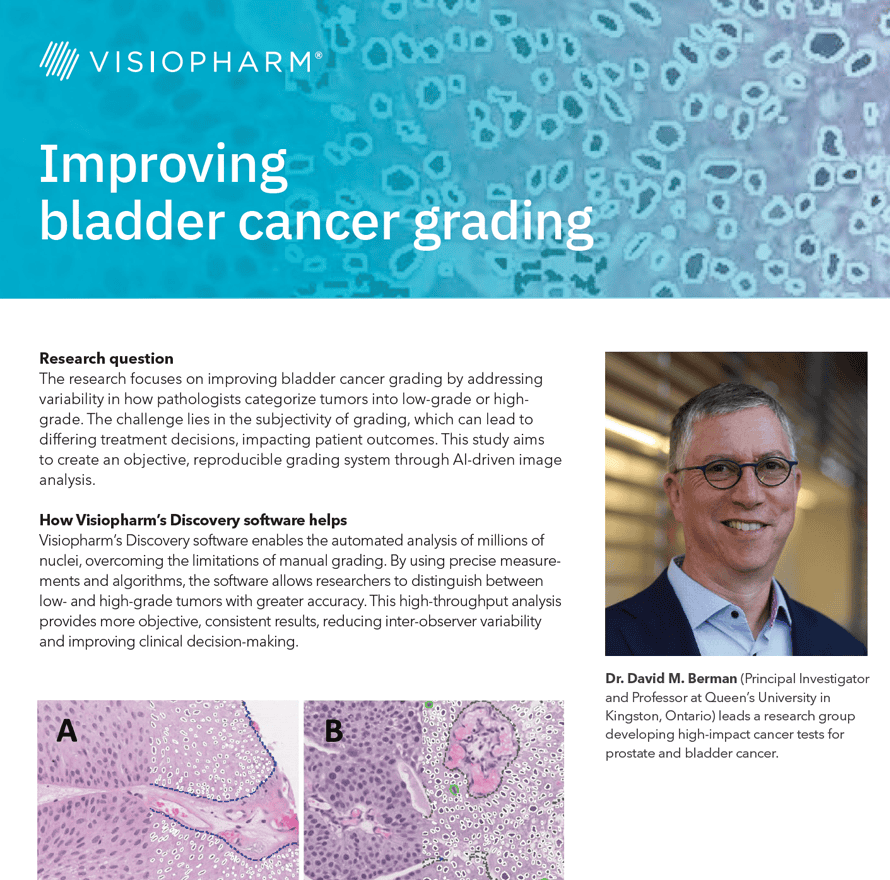
The research focuses on improving bladder cancer grading by addressing variability in how pathologists categorize tumors into low-grade or highgrade. The challenge lies in the subjectivity of grading, which can lead to differing treatment decisions, impacting patient outcomes. This study aims to create an objective, reproducible grading system through AI-driven image analysis.
How Visiopharm’s Discovery software helps
Visiopharm’s Discovery software enables the automated analysis of millions of nuclei, overcoming the limitations of manual grading.

Visiopharm’s Discovery platform bridges the gap between expert domain knowledge and scalable, objective analysis on human or animal tissue with AI-powered software. Researchers can use Discovery to study the biology of disease, identify druggable targets, or develop companion diagnostics. Without having to code, the platform allows users to develop customized algorithms tailored to their research. That means you are in the driver’s seat and AI serves as a powerful extension—not replacement—of human knowledge to advance precision medicine.
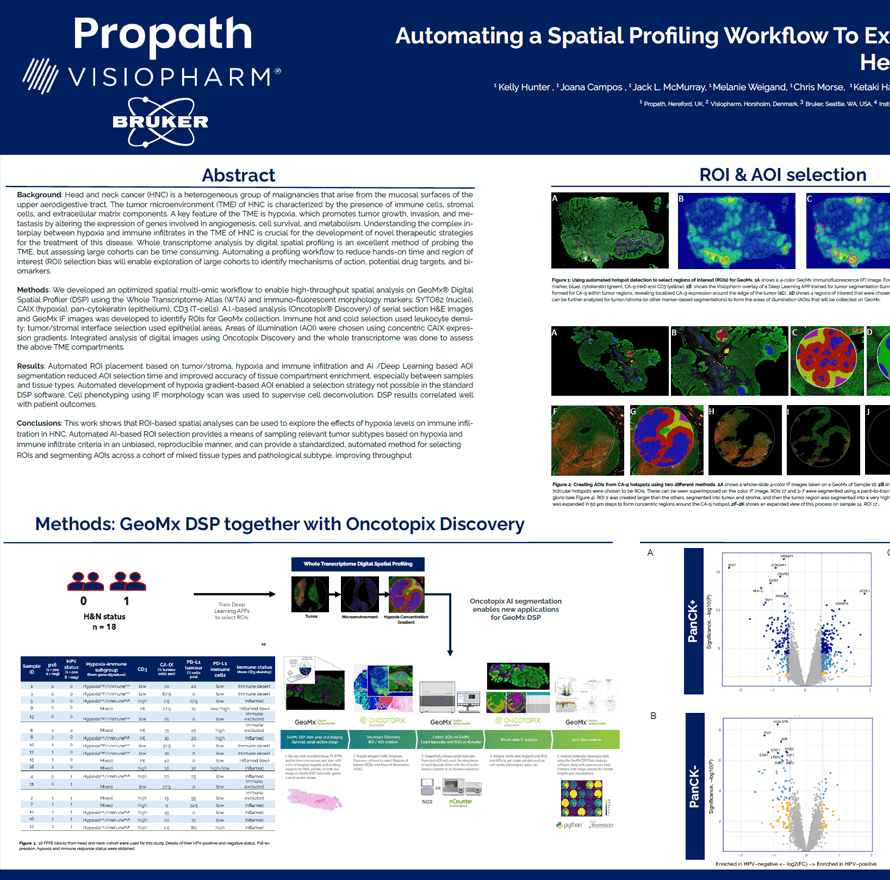
Head and neck cancer (HNC) is a heterogeneous group of malignancies that arise from the mucosal surfaces of the upper aerodigestive tract. The tumor microenvironment (TME) of HNC is characterized by the presence of immune cells, stromal cells, and extracellular matrix components. A key feature of the TME is hypoxia, which promotes tumor growth, invasion, and metastasis by altering the expression of genes involved in angiogenesis, cell survival, and metabolism. Understanding the complex interplay between hypoxia and immune infiltrates in the TME of HNC is crucial for the development of novel therapeutic strategies for the treatment of this disease. Whole transcriptome analysis by digital spatial profiling is an excellent method of probing the TME, but assessing large cohorts can be time consuming. Automating a profiling workflow to reduce hands-on time and region of interest (ROI) selection bias will enable exploration of large cohorts to identify mechanisms of action, potential drug targets, and biomarkers.
Kelly Hunter1, Joana Campos1, Jack L. McMurray1, Melanie Weigand1, Chris Morse1, Ketaki Hardikar1, Jeni Caldara2, Regan Baird2, David Mason2, Kyla Teplitz3, James Mansfield2, Hisham Mehanna4, Jill Brooks4
- Propath, Hereford, UK
- Visiopharm, Horsholm, Denmark
- Bruker, Seattle, WA, USA
- Institute of Head and Neck Studies and Education, University of Birmingham, Birmingham, UK
 Sheila Hansen
Categories:
26734
Development of a multiomic workflow using Oncore Pro X to stain tissues for high performance Dual Channel™ Validation of RNA expression with downstream quantitation using AI-based image analysis with Oncotopix Discovery™
Sheila Hansen
Categories:
26734
Development of a multiomic workflow using Oncore Pro X to stain tissues for high performance Dual Channel™ Validation of RNA expression with downstream quantitation using AI-based image analysis with Oncotopix Discovery™
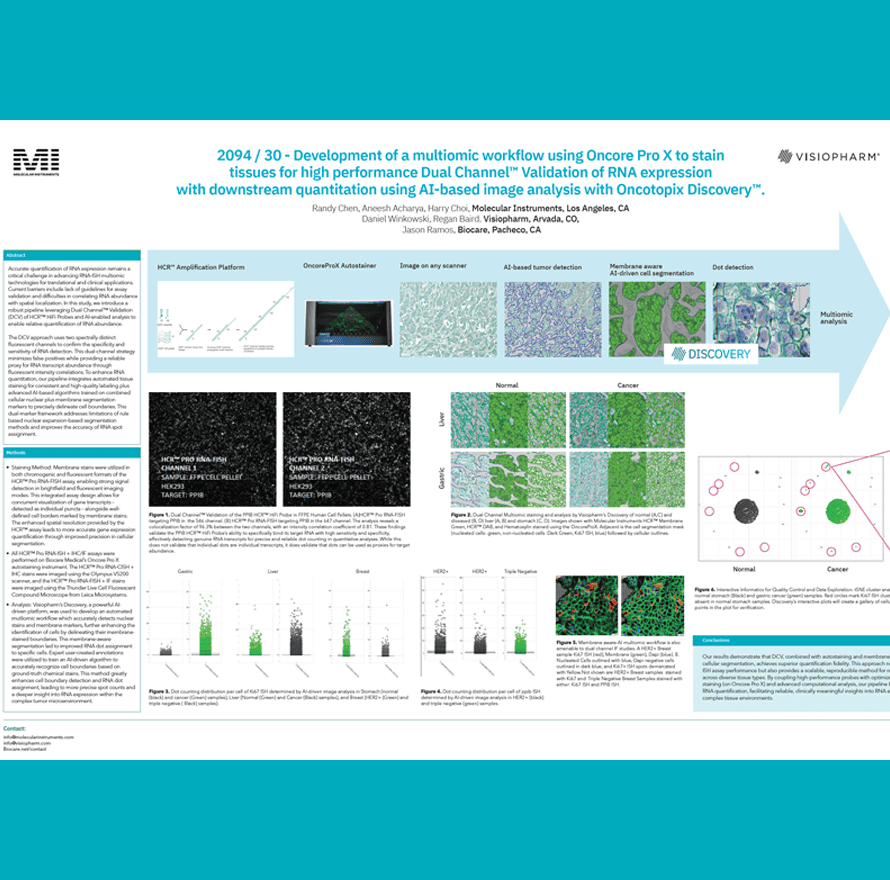
Accurate quantification of RNA expression remains a critical challenge in advancing RNA-ISH multiomic technologies for translational and clinical applications. Current barriers include lack of guidelines for assay validation and difficulties in correlating RNA abundance with spatial localization. In this study, we introduce a robust pipeline leveraging Dual Channel™ Validation (DCV) of HCR™ HiFi Probes and AI-enabled analysis to enable relative quantification of RNA abundance.
The DCV approach uses two spectrally distinct fluorescent channels to confirm the specificity and sensitivity of RNA detection. This dual-channel strategy minimizes false positives while providing a reliable proxy for RNA transcript abundance through fluorescent intensity correlations. To enhance RNA quantitation, our pipeline integrates automated tissue staining for consistent and high-quality labeling plus advanced AI-based algorithms trained on combined cellular nuclear plus membrane segmentation markers to precisely delineate cell boundaries. This dual-marker framework addresses limitations of rule based nuclear expansion-based segmentation methods and improves the accuracy of RNA spot assignment.
Randy Chen1, Aneesh Acharya1, Harry Choi1, Daniel Winkowski2, Regan Baird2, Jason Ramos3
- Molecular Instruments, Los Angeles, CA
- Visiopharm, Visiopharm, Arvada, CO
- Biocare, Pacheco, CA
Sheila Hansen
Categories:
26735
Relapse prediction of stage III MSS colon cancer by certain cell subtype distribution characteristics in tumor and tumor invasive margin
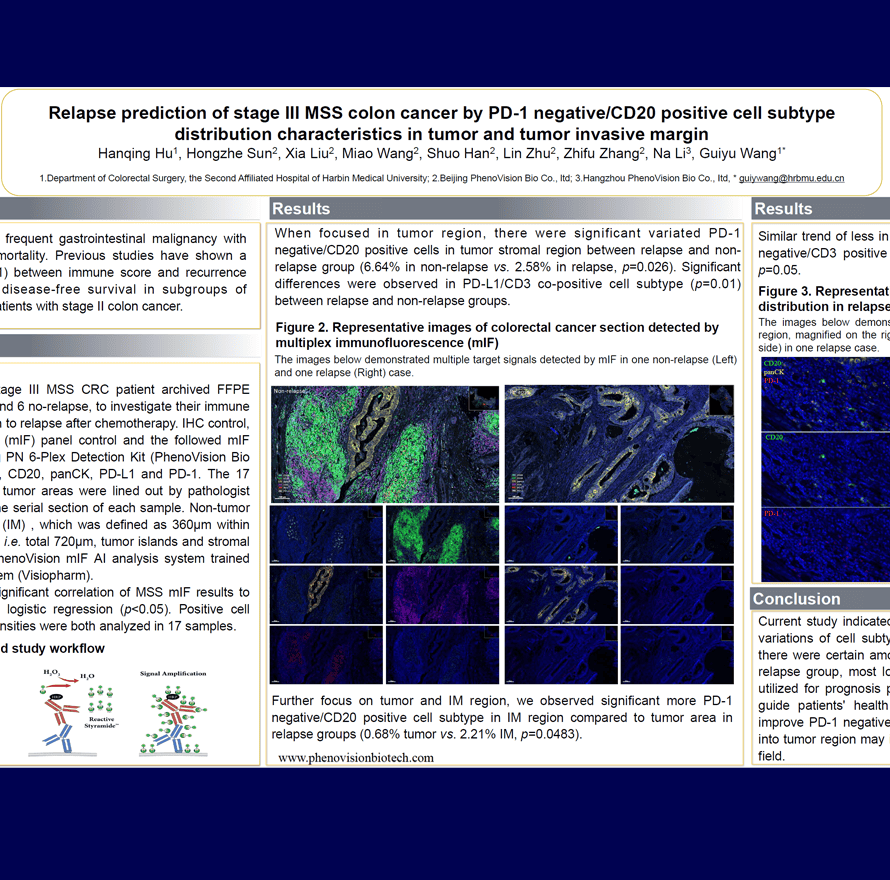
Colorectal cancer (CRC) is a frequent gastrointestinal malignancy with high rates of morbidity and mortality. Previous studies have shown a significant correlation (p<0.001) between immune score and recurrence time, overall survival, and disease-free survival in subgroups of microsatellite stability (MSS) patients with stage II colon cancer.
Hanqing Hu1, Hongzhe Sun2, Xia Liu2, Miao Wang2, Shuo Han2, Lin Zhu2, Zhifu Zhang2, Na Li3, Guiyu Wang1
- Department of Colorectal Surgery, the Second Affiliated Hospital of Harbin Medical University
- Beijing PhenoVision Bio Co., ltd
- Hangzhou PhenoVision Bio Co., ltd
Sheila Hansen
Categories:
26380
Enhancing RNA-ISH spot detection with dual-channel staining and AI analysis

Ensuring accurate RNA detection within specific cellular contexts is essential for advancing translational research and clinical applications. However, the lack of robust validation of probes targeting newly discovered RNA molecules remains a key bottleneck for clinical translation. Accurate identification of RNA within specific cells, particularly in cytoplasmic regions, presents a significant challenge due to difficulties in determining cell boundaries and ensuring probe specificity.
In this webinar, Molecular Instruments will address these challenges by introducing Dual Channel™ Validation, a novel approach that assesses both the specificity and sensitivity of HCR™ Pro RNA-ISH. This comprehensive evaluation facilitates the translation of high-value RNA-ISH assays from research to clinical settings, ultimately enabling reliable RNA quantification. Additionally, experts from Visiopharm will discuss the integration of their Discovery software, a powerful deep-learning solution powered by AI that enhances the cell segmentation and RNA spot localization, leading to improved RNA quantification especially within the tumor microenvironment.
We will discuss how the combination of protease-free RNA-ISH, co-detection with protein markers, and AI-powered cell boundary recognition unlocks new possibilities for high-fidelity RNA visualization in clinical research. Join us to explore how this end-to-end assay validation strategy can improve the accuracy and clinical relevance of RNA-ISH analyses.
Key Learning Objectives:
- Understand the limitations of traditional RNA staining techniques and how MI’s Dual Channel™ Validation enhances specificity and sensitivity in RNA-ISH assays.
- Learn how AI-driven cell boundary detection using Visiopharm’s Discovery software improves RNA localization and quantification accuracy.
- Explore the power of integrating HCR™ Pro RNA-ISH with Discovery, enabling high-precision RNA quantification within complex tissue environments.

Regan Baird, SVP Research Commercial Strategy Deployment at Visiopharm
Regan Baird, PhD received his degree from Temple University in Philadelphia, Pa. in Biochemistry and Postdoctoral Fellowship at the Beth Israel Deaconess Medical Center in Boston, Ma. Dr. Baird has spent the past 2 decades in cellular and tissue imaging and analysis. Dr. Baird is currently Visiopharm’s SVP of Research Commercial Strategy Deployment. Talk to him about the practical aspects of AI, Machine Learning, Deep Learning, Tissue Multiplex, and Clinical Integration.

Dan Winkowski, SVP Research Commercial Strategy Deployment at Visiopharm
Dan is a senior technical specialist in image analysis, supporting the US sales team for Visiopharm. He was trained as a neuroscientist and has spent over a decade in academia, specializing in advanced imaging methods and designing automated digital image analysis workflows.

Randy Chen, Director of R&D at Molecular Instruments
Randy is the Director of R&D at Molecular Instruments. He joined MI as a scientist and led the development of HCR™ Pro RNA-ISH protocols for major automated platforms, including the DISCOVERY ULTRA, BOND RX, and ONCORE Pro X. His work has enabled seamless integration of HCR™ assays into biopharma and academic workflows. Currently, Randy is focused on advancing next-generation HCR™ products and expanding the technology’s applications into the clinical space.