
Transcript
Good afternoon, ladies and gentlemen. Hope you’re keeping well. Welcome to this webinar, challenges of IHC standardization.
I know a lot of you will have received this, invitation from UK NEQAS and are probably expecting Andy Dodson here at the moment. Unfortunately, Andy’s been unable to join us, had to drop out for personal reasons. So I’m going to be chairing this webinar today.
For those that I don’t know who are online, my name is Matthew Burke. I’m an account executive for Visiopharm.
Visiopharm is a AI software company specializing in precision pathology and we’ve worked closely with UK NEQAS for a number of years to support and work through potential solutions regarding the challenges that are seen in IFC that all of you will be all too familiar with. We’re really going to be focusing on that today. So today’s webinar will be looking at the VisioPharm Qualitopic Solution, which is a software solution to provide quantifiable measurements of IFC using image analysis of standard control materials.
Just to let you know that this webinar will be, filmed and will be made available to you all later, so you can go back, review, you don’t have to sit and take notes all the way through. Please sit back and enjoy the webinar.
If you have any questions that you would like asking to our presenters today, then please put those into the chat, section of Teams. We will pick those up, and we will go over them at the end. Any of those that we’re unable to answer at the time, we will try to get a response back to you.
So, I’m joined today by, two two specialists in this area, my colleague, Mat Tylicki and, Colin Tristan from HistoCyte.
Mat is a Global Product Manager from Visiopharm and has been with the company for three and a half years, having previously worked with, CarryOn Medical and Global Assembly.
I’m sure many of you will know Colin, he’s been in the IHC world for a little while now. I think it’s fair to say Colin.
Many of you will know him from his time working at Novocastral Laboratories and developing monoclonal antibodies.
He was also involved with developing the HER2 cell line assay, which is used by UK NEQAS.
And he was part of the original team to bring the bond systems to the UK market.
Having support customers across UK, Europe and the US, Colin went back to R and D and was Head of Innovation at Leica Biosystems in Newcastle.
He then co founded, HistoCyte in twenty fourteen and is currently the CEO at HistoCyte.
So we are really looking forward to sharing lots of information with you today. We hope it will be a useful, beneficial, and interesting webinar for you all. As I said, please put any questions into the chat box and I will hand it over to Mat to kick us off. Thanks, everybody.
Thank you, Matthew.
Well, thank you again, everyone, for, for making the time in your busy day to join this webinar on an important topic.
As product manager at Visiopharm, I I lead a multidisciplinary product team to build and evaluate the Qualitopix platform.
That is a platform to support labs with assay standardization.
We’ve been working very closely with with, EQAs like UK NEQAS, Nordic QC, and and others, but also vendors producing the standardized reference material like HistoCyte, that they’re presenting today, as well as other visionary biomedical scientists and and lab managers around the world as a part of the early access scheme for this product. In terms of the presentation today, I’m just gonna give our.
I’m gonna jump into the the challenges, with IHC standardization of the analytics side. What are the root causes?
Then I will, switch gears to talk about the Qualitopix solution, how that can be, what it is, how that can be implemented in labs. And then finally, for the labs or part of our early access program, what are some real world examples of what these labs have have detected and how Qualitopix help them, in their day to day? So, yeah, just a quick overview. So Visiopharm is a Danish pathology AI company with over twenty years of experience. It was founded in two thousand two.
The HQ is located just outside of Copenhagen Copenhagen and Hoersholm, but we have a global presence in the Nordics, UK, Germany, and the US, as well as a significant customer footprint spanning over forty countries. With Visiopharm’s, AI driven solution, we target, both the research and diagnostic markets. In diagnostics, we have over nine CE-IVD, cleared applications for use.
And in the research space, we have over a hundred and twenty, ready to use apps, but also the platform is infinitely configurable, for for for end users to be able to build their own, build and train and validate their own applications.
So we work with a wide, range of partners. You can see here on the screen, both to integrate our software or or distributors like, Agilent.
But this makes Visiopharm very well positioned to, to be able to support end to end workflow solutions for labs. So let’s dive into the problem. What are the challenges with analytics standardization and and their impact?
So as you know, predictive IHC has been used for many, many years now, and that’s that’s to determine and and select the right treatment, for for a number of cancers. For instance, the HER2 test is, as you know, associated with Herceptin, ERPR test with tamoxifen, or letrozole, PDL one with Concentrix, etcetera.
But we also have, some new markers emerging. You may have heard about the HER2 low and the HER2 ultra low, which was recently announced at, the ASCO meeting, in the US.
And with these, HER2 low and HER2 ultra low, they’re they’re tied to a a novel antibody drug conjugate called HER2 for for treating breast cancer.
With these tests, these require the distinction between of a negative case, with one that is positive but can have an extremely small amount of antigen present. This really pushes the boundaries of what is currently possible with IHC.
At the same time, standardization very much remains a challenge across the entire workflow from from biopsy through fixation, sectioning, staining, and interpretation by the pathologists.
Errors happen, pretty much each of these steps and accumulate across the workflow.
So in a digital workflow, you actually add even more sources of error.
For instance, view with the scanner, scanning of the slides or the display itself.
Or if you’re using AI algorithms for decision support, there may be data drifts or maybe problems with the generalizability of your, algorithm creating errors.
But today, we’re very much going to focus on the analytic or staining part only, which is on its own. It’s a significant source of error.
In the bottom left, you see results from, a Danish EQA provider, Nordic QC, and that is based on thirty over thirty thousand, tests done in their q QA runs, over five over a five year period. And it shows that, labs have twenty one percent of labs have insufficient staining.
So double clicking on that, kind of where where do those errors, come from? Well, there are two critical challenges that under underpin this high analytic error rate in IHC.
The first one, is around the precise measurement of the assay’s analytic sensitivity, which is currently completely absent in IHC.
The second side, because once the optimal level is attained, another challenge is ensuring consistency across instruments, reagent batches, positions, etcetera.
And on the topic of consistency, here is here is a snapshot of of of results from, from UK NEQAS, and this represents seven PDO one saving runs as done by UK NEQAS for, for for selected number of labs.
As you can see, laps can fluctuate from having sufficient staining quality at one run, and then drifting to to have insufficient, staining at the next one. So there is inconsistency, and you can see that, from the EQA runs, but also we have seen that from the early access programming Qualitopix, how much actual day to day variation there can be in lapsed, and we’ll double click on that later in the presentation.
So why is why does IHC have such a high, analytic error rate?
Well, in his publication, doctor Steve Bogan did a comparison with with clinical chemistry, as as a way to compare these two disciplines and potentially point to, to the root causes from these differences between clinical chemistry and IHC.
As you can see in the graph on the left hand side, clinical chemistry had, analytic error rates in in the same order of magnitude as as, IHC, back in the fifties and sixties. However, they dramatically, reduced, around the year two two thousand.
So they went from fifteen to fifty percent to, to less than one percent.
The the the y axis scale here is log logarithmic on this plot. Whereas if you consider the plots on the right for IHC, the IHC error analytic error rates very much remained, the same with different, publications actually putting them between ten and thirty percent.
And the blue area here represents the opportunity for improvement in IHC. So So what are the key differences between, IHC and some of the changes that, clinical chemistry have implemented?
Well, first and foremost, one of the key differences is that IHC has no quantitative calibrators, or in other words, it doesn’t have the same yardstick that everyone and every assay is measured against.
So this is unprecedented, with all the other clinical disciplines have, calibrators. If you look at the graphic on the right hand side, this is for cellular logic, immunoassays that have calibrators that help, separate the true negatives and the true positives. These are traceable to what is known as primary and secondary reference standards.
In IHC, that is absent, so you cannot you cannot determine exactly what is the, analytic cutoff, but also other parameters such as lower limit of detection or low limit of quantification.
Another key difference and challenge, and Colin will, will touch on this later in this this webinar, is the types of controls that are used.
So in IHC, often, only positive or negative controls are used, and the positive control may be so positive that it will fail to detect changes in assay performance, due to it being beyond the assay’s dynamic range.
This means that only a dramatic change in in assay performance will cause a visual jump in the control, whereas the more subtle changes may go undetected in the lab.
Secondly, tissue based controls can have high levels of heterogeneity, within a block and between blocks, as as seen in in our studies, which means that you potentially miss out on on certain patterns and changes within the within the assay. And finally, there’s lack of traceability of these known concentrations, and and, some labs still do not use on slide, controls for even for the predictive markers that are tied to, therapies, even though it’s in the in the minority.
As the third key difference, between clinical chemistry and IHC is is the lack of continuous and objective measurements as a part of the QC process, but also using using these quantitative plots known as levogennings.
So in clinical chemistry, these, very much are used, day in, day out, as a part of their QC process. And they’re they’re used effectively as a war early warning system. So if an assay drifts or or there’s some change in statistical pattern, the end users can pick up pick that up, and and take corrective, actions in a timely manner without it impacting the downstream too much.
But the field is very much recognizing that there is an issue and and proposing a road map for for improvement.
So last year, there was a groundbreaking, editorial published by doctor Clyde Taylor, one of the fathers of IHC, and then, his colleague Barbara Jean McNaney, and they proposed that IHC should be regulated as an assay and not a stain.
And what that means, and this is from the College of American Pathologists, archives publication, is that the checklist standards should be harmonized between IHC and chemistry, meaning that they they should have, the same, types of, controls so that the lab must establish a perfect QT range.
The control concentration should be at relevant decision points, so close to the cutoffs.
The QC data should be evaluated daily in a manner that’s suitable for detecting trends, and and and shifts, known as the LiBAR genetics, plus.
But that’s not the only proposal and change.
There’s also been, modifications to the ISO fifteen one eight nine, guideline, which stipulates the use of third party controls, but also the use of statistical methods and and and, enhanced monitoring to detect to detect, shifts and trends in in assay performance.
So off the back of the, Taylor McNaney editorial, there was a number of, editorials, published since then.
For instance, the the top one that you can see from from UK NEQAS, very much supporting the, the proposed changes.
There was another editorial from, the National Society for Histo Technology, across the pond.
Again, supporting these changes, here’s here’s one of the quotes from the editorial. I actually test quality assurance is granted in subjective past fail interpretation based on nonstandardized controlled tissues that are insensitive and reproducible.
And finally, in the bottom, you see a quote in the editorial from, a key opinionated pathologist in the US, David Rim, which again supports all of these changes.
So now that we have, defined the problem, let’s dive into, our solution, Qualitotics.
So Qualitotics is a web platform, that enables you to, track, your assay performance over time, on Levi Jennings plots, with these next generation standardized reference material, so that there’s the cell lines, peptide coated microbeads, and this is not relevant for, for IHC, but for for HME, also on tissue mimicking biopolymer.
So labs would purchase this material from, from the vendor themselves and then place them on the slides, either next to the patient tissue or or, kind of run on separate slides, and stain them through using their routine protocol, scan them, and upload them to to the web platform where the analysis happens automatically.
Shortly after upload, you receive a notification that the results are ready and and, it indicates whether you are within your acceptance boundaries or outside of them. If you’re outside of your acceptance boundaries, then it is up to the lab to, to decide on on the next steps and and if corrective action is is is required.
And now I’ll play a short video demonstrating the Qualitopix platform.
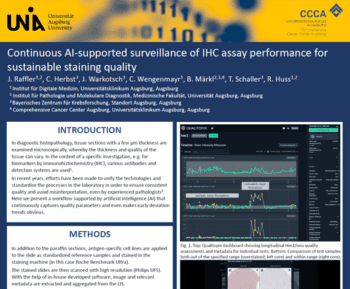
Qualitopix is an AI powered tool designed to assist laboratories in maintaining consistent staining of high quality.
The Qualitopix front page shows the available services and if the latest tests require your attention.
To investigate the results for an individual service, click view.
The ER service consists of four cores, which is represented by four plots.
Each cell line core is represented by a dot on each of the plots.
You can click a data point to get more details about the staining date, scanner, staining instrument etc.
To get an overview of the individual stainer performance, you can use the Split By feature.
Here we see outliers coming from a certain staining instrument, so we will investigate this further.
Click edit view details to visually inspect the data.
You can use the compare feature to visually compare with a core within range. This can sometimes make it easier to understand why the score is different.
In this case, it turned out to be crystallization on the nozzle tip. In the timeline, we can see the inconsistency and that the machine returned to its previous performance level after correcting the issue.
So as you saw in the video, Qualitotics helps to easily identify when outliers are happening, but it also has built in tools for streamlined, troubleshooting, to help you visually assess, the differences, but also be able to track all the, all the metadata, associated with with the tests, which which can help, identify what the what the root causes may be in the troubleshooting process.
But here on this slide, we show how, Qualitopix works behind the scenes. The process is fully automated, as an image of a cell line, and in this case, the the the diagram is for for cell lines only. The algorithms work a little bit differently for the beads or the biopolymer.
But when the image of the cell line is is uploaded to Qualitopix, the the algorithm would find in, each cell line core and and classify it. That would remove artifacts, from the analysis, for instance, it could be blurred areas or or clusters of cells or or folds and hairs. These will all be removed from the analysis.
Then the algorithm would perform, the task of finding, the cells and classifying the cells. And the classification happens slightly differently if it’s a a membrane marker or a nuclear marker, but each and every cell within the core is is classified.
And the final output, and this is the same regardless of which, which marker this is for is, a normalized score between zero and one hundred. So you can continuously track what is happening with your, with your assay.
So we’ve seen labs, implementing Qualitopix in in in different workflows. Here’s the first one that I’ll introduce to you.
We call it a daily or batch workflow, where labs would perform one test per stain or a marker, for instance, daily. These tests will be barcoded and encode the barcode. The barcode would encode the barcode container in position, and then the slides will be scanned, and names automatically generated from the barcode labels.
And then either manually or automatically, these would be uploaded to Qualitopix, and shortly after, the analysis will be available and, the appropriate end users would be notified. And at that point, the the biomedical scientist or the supervisor would review the dashboard. And if there are, outliers, they would instruct instruct the rest of the staff for the production flow for that day or or or guide help guide troubleshooting.
To help with this specific workflow, and this is for labs that do not have access to a scanner or or maybe the scanner is in a, on a different floor, of the lab where it’s it’s not accessible for other reasons, we can offer a, desktop dedicated scanner for quality, from the company called Verundium, and it would provide automatic uploads to Qualitopix, and to Labs, being interested in placing these somewhat close to the scanners, easing removing friction from this workflow.
Workflow that, runs fully in the background. And, in this case, labs would, at least for their predictive markers, add cell lines on each and every predictive slide, and and could barcode them, including biomarker, cellular position, and then scan them, and and from directly from the scanner or PACS IMS, those tests will be automatically created, in an anonymous way and uploaded, to the Qualitopix cloud for processing.
And labs, in this scenario, would have a a a live dashboard where they can monitor their production and and kind of then and there on the spot they see if there are outliers and if they need to take corrective action. And through our encryption and normalization process, they would be able to, actually pinpoint the individual tests that failed, to individual patients or or tests, so they can restain and and rescan if needed.
So while this option requires some more work to get started, some of the key benefits around this is that well, the goal is this greater standardization because you’re testing, for predictive markers everything that goes through the production. But there’s also some, important efficiency gains, for instance, that come from streamlined quality control process or the workflow around preparing the controls. So if you’re moving as a lab from from preparing tissue based controls, a lot of that work will be removed by moving to a ready to use setup.
Maybe in the interest of time, I’ll I’ll, I’ll just quickly, say that Qualitopix is is, very much compatible with different, reference materials, staining, instruments, biomarkers, and clones that you see here, here on the screen. A lot of them are from Hethasite, and then more are coming soon.
So with that, let’s shift gears into, some real world examples of what Qualitotics has picked up, as part of the early access program.
So over time, working with with several labs, we began to see an entire gallery of issues that can be, that that were detected by Qualitotics and can impact staining consistency.
So we’ve we’ve started seeing these patterns and and defining classes, of issues either relating to the instrumentation, the clones, the the batches, or or the protocols.
So, for instance, there there’s a bucket of issue where where it’s related to a global instrument instrument assay or protocol problems, for instance, with the vortex or the detection kit or, the the protocol may be a a a suboptimal.
And there are position specific instrument issues.
For instance, problems with the heating pads. We’ve seen issues with, the leveling of the slide trailer or the ins, or, yeah, other other problems. And finally, and this is, interesting differences that are driven by both the global instrument and position specific, issues.
So here is, yeah, just a a growing list of issues that we, we regularly, pick up even at the best of labs. These are not necessarily happening often, but they can be hard to pick up, by the naked eye, by manual processes.
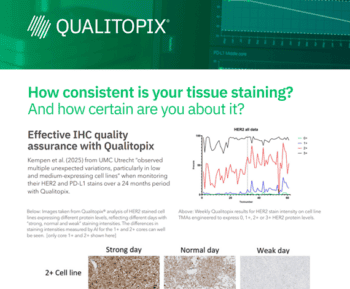
And in a lot of cases, many of these issues are probably impossible to to avoid. Here on the right hand side, you have an example of, two clones per two, and each of the each of the lines represents different cell line cores. The bottom is the negative and the low, then the middle and the high core. And this lab, after implementing Qualitopix, they saw quite a bit of variation, kind of on their HER2 clone.
And they, that that caused them, concern. They’ve they’ve, where the solid line begins, they’ve switched to a different clone, clone two, and where the where the dotted line is, they’ve optimized their their protocol. As you can see, a quite significant difference and more more more stability with, with clone two after the after the optimization, which, the lab was was able to quantitatively prove and track over time.
But there are other issues.
For instance, in this case, this is a lab in Germany that had a bad, reagent lot, probably, maybe, deteriorated during transport. But with Qualitopix, they were able to detect issues.
They saw a significant spike in their h scores across all the cell lines cores on on HER2.
So switching the reagent batch caused the staining results to get to, to normal, as you can see here on the left hand side in the plot.
Here’s another example, and this is from a lab, a large lab in the US where they were, actually doing intrastainer testing. On the plot on the right, you see the different, positions within their staining within a single staining instrument within this is all data generated in in the same run. So as you can see, quite a bit of variation, with a number of outliers, close to or or exceeding two standard deviations from the from the mean.
But after double clicking on on on these, they actually found a number of, heating pad issues, which they verified with these temperature checks slides, but also then looking in within within their system and and and seeing if if the correct temperature was, achieved on those heating pads.
So with Qualitotics, this actually acted as an early warning system helping them detect that there are issues sooner than maybe they would have normally.
Here’s, a final example, and this is, again, positional inconsistencies within, a number of runs of the same instrument.
So this is again for her to, On the x axis, you have the different position positions within the, the instrument, and this is for, for for core three on HER two. The the light pink, bars represent, the test before cleaning and maintenance, happened on the instrument. As you can see, the standard deviation was, ten point five with a mean result of forty six point five. And after cleaning and maintenance, this is the darker, pink bars.
The standard deviation, dropped quite significantly to three point sixty eight.
And the, and the mean, for all tests was closer to a for all these, but also the other other stainers within that specific lab that is not represented on this plot.
So clearing and maintenance, kind of the key messages here is that that it can very much, lead to, to consistency, between the positions in the instrument.
And with that, I’d like to thank you for your attention. I’ll hand over to, to Colin for his part, and then we’ll take some questions in the end.
Thanks, Matt.
Should just, share my screen.
Okay. Can you see my presentation? Yeah. We’ve got it, Colin. Thank you. Awesome.
Okay. So, thanks guys for allowing me to come and talk about a subject that, I can clearly talk a lot about. I shall try and limit it today, and specifically looking at, the standardized controls and, how they come about, what, unmet needs we’re trying to, address in the laboratory and, of course, how they fit in with, with with key topics, in particular.
So it’s mentioned previously I have a background in an assay development and I’ve made the HER2 cell lines that are currently used by Nikwass and they’re the same cell lines in the, the Leica HER2 kit and the reason is because you can standardize them. And why do we want standardized material? Well if you look at how materials are handled in the laboratory there are multiple genes for variation and none of them through anybody’s fault. It’s simply a reflection of the the process of which we have to work.
So when biopsies are taken we have you know the cold ischemic time, we have time and fixation and of course fixatives vary sometimes from from laboratory to laboratory. There are some regional variations. Some some countries will prefer the fixatives, but, the point being is that, time the samples taken and when samples removed from the from the body, it starts a cascade of events where the material starts to degrade, cells start to take your toes and that’s why we fix it we we observe that material. So of course that time is critical and then the time in fixative and we have these kind of windows that are are acceptable.
I would say the biggest issue is under fixation but we do see problems with with fixation that has to be excessive.
We then look at the tissue processes and we have multiple vendors, polls and we tend to use a one size fits all with particular samples and we have to because of the volume that that that goes through them.
The materials aren’t standardized for a start. You know, no two biopsies, receptions are the same. Their content varies. You know some of them are more vascularized. The the the formula will be able to penetrate more effectively than you know a solid mass. So there’s all these elements that that mean again these samples aren’t standardized.
We go into embedding of course this can be in the wrong way it can be melted and reorientated.
We do see some variation with section thickness.
You see a lot of these assays they they them in four to five microns.
No laboratories are used anywhere between three and five and there’s a lot of that shows you you know the thicker it is the greater effect it can have because of the children being more more fruiting.
Point five where the assay is done. That’s where we can put a stake in the ground and say, you know, this assay is run as it should.
It is, it’s a validated assay. It’s reproducible and it’s worked as it has done before and this is where the quality control comes in. And this is why the way machines are designed these days with you know a slide being treated independent you need a slide control same slide control days of when I started doing I mean I would choose and pots and pans and whatever controls were but not anymore.
And then lastly we go into kind of interpretation analysis is about diagnostic confidence as my test run as it works the way it has always worked is the way it to and and what more can we take from with with image analysis.
So as I said with the issues, innate issues with with tissue, the problem is we’re looking at biomarkers in in tumors and they do strange things. I mean heterogeneity is is not uncommon and there’s an image there to the right from a penny to a needle where you’ve got, a three two one, the two expression in very close proximity.
We also see you know various fixation and processing artifacts and as I mentioned no two tissues are the same so they can’t really be standardized and we didn’t have an infinite supply. So you know the most frequent complaint in laboratories is they might find material that looks great but, you know, soon exhausted when you’re having to use it in these these volumes.
And these changes in tissue quality have an equal effects.
I mean most, assays are standardized.
You see subsequently a lot of laboratories will have variations within what are supposedly standardized assays. So they might increase the antibody incubation, for example, or they might tweak with the with the, the epitope retrieval.
And and all of these mean that actually the disconnection between between sites and that and they’re outside of the those kind of, guidances stipulated in the IFU and the the analyzed assays go through a lot of validation you know they use masses of of clinical samples to actually correlate some of the results in response and so on so there is a reason why those are stipulated in the design of FEWS but nevertheless laboratories can tweak and it means that you you can, drift.
We also see a lot of, bias our tissue is just and you know it is within your laboratory.
But by every lab I go to will tell you that you know a neighboring hospital’s tissue is never as good as theirs and so the question is is isn’t it genuine or or the issue with within their own laboratories and and as I say this is the deal was fit for purpose. You get you can run it down. What we’re talking here is is, you know, so you standardized, tariff quality control, which is why tissue doesn’t always necessarily lend itself to it. And, of course, the other thing is I’m I’m told it’s free. With the amount of scientists and technicians involved in managing control material, it takes up a lot of resource in these in in labs that, where where the time is very precious.
So if we’re looking at the raw material, what do we really want if we’re using, the raw material for a standard in in chemistry for tissue? These are the kind of elements we want to be able to cover.
So firstly.
Is it robust? So it’s not only can it withstand administer chemistry, but how do I use it in situ hybridization, which again introduces other things that are quite aggressive with with material?
Is it reproducible? Key question. I see when, batch results. Is it stable for us? Is it standardised?
Is it easy to manufacture? Is it scalable? Can we have an inexhaustible supply?
And when we’re looking at biomarker expression, you know, the variety of they’re looking at protein, RNA, DNA. It’s it’s not just being able to, kind of validate material from one perspective. It’s being able to use other means to to demonstrate its its validity.
Morphology and histology so you know we try and preserve the original morphology of the tissue so it’s quality morphology because I can tell you very much if that’s if that’s disrupted as a part of the process then you can start reflecting on what’s happened in the when it’s been overtreated, has it been heat spikes? And we see that. We see a distortion of in the material, the the patients with the samples in in biopsies. So, you know, do we have that as a as a quality measure in our material?
Localization, it contacted you know, is this, localizing in the in the cytoplasm or the membrane of the nucleus, as as intended?
And, you know, as I said, inexhaustible.
These, you know, it it might adopt this very easily. Isn’t it? Block doesn’t fit into our current, workflow so that, it isn’t too disruptive so I don’t have to buy, you know, thousands of slides and and and of course the the refrigerators you might need to keep them.
So we see new texts, new tests, new standards. So this same site control demand has increased by virtue of of the instruments that operate these days. And and of course we’ve seen increased demand just through through volume, but also as you know claims are extended for HER2 so we’ve gone from breast into into gastric and probably being there.
And of course the ER and PR in in breast. We we’ve seen these new rare events so, ALK, so the EML4 translocation, there’s a number of EML, ALK translocations associated with lung but this is probably the most predominant but again it’s in like less than three percent of lung cancer cases so not every laboratory has this material to hand. It’s it’s rare by by its nature and ROS1 is is part of that and we we’ve seen others on the on the horizon.
So labs struggle for for for control material and it’s already been touched on by, you know, the standards there these international standards they’re talking about.
You know the use of external standards to help with with the employee’s control.
So where does this lend us to? Well you know some of the behaviours in clinical chemistry the way that they run their standards and I won’t come into the CASS but you know you don’t consider these as part of being standards so you might want to scan everyone and measure every one of them but you can do that and you can certainly do it on a daily basis to to collect that data and look at how you, how your laboratory is performing and and potentially how you perform versus others.
But more importantly, you know, troubleshooting candies controls, tell us more. We’ve frequently been asked or told ourselves don’t work, but actually when we’ve investigated further, we’re able to demonstrate that, there’s been a change in chemistry and and Matt’s already alluded to some of those examples and we’re we’re currently working on that with a number of customers. So you know they would typically see the the mid and the low.
Drop and and then it’s a case of, you know, why is that happening? What’s happening with the with the chemistry when you know a bunch of controls is being used consistently?
It lends itself to the troubleshooting, so it opens up these possibilities of what we see in these controls reflecting on on root causes.
For example, you know, here we’ve got no dewax versus a normal run. And on the right hand side we have, images from, from, for HPV. So here we’ve got the right hand side. That’s a kind of gold standard in this result. Morphology is retained on the other things. You know, it’s so digested. You have potential heat damage, but we we found out there was an extended prototype digestion.
So this image analysis allows us to be more objective about what we’re looking at and quantify these these elements, remove that degree of subjectivity.
In the chemistry there’s so much built around aesthetics, how what we look at, you know, we know, you know, some pathologists prefer using a little capsidane for example there’s there’s so many elements in there that create confidence or familiarity.
Image analysis we’re able to kind of remove the subjectivity and and and be able to use these materials to support the decisions we’re making in these these laboratories.
So this is the PDL1. You’ve seen some images from from Matt already but I mean we use these with the all our QC done with for with Qualitopix and we’re able to run and we’re able to see ourselves how you know the chemistries are affected over time but we’re also we’re able to use these standardized assays as intended and, quality control these materials whether it’s validated materials, but we’re also using it as quality control. So we know how it works, forms before it needs, our our facility.
We’re able to use, the quantity software to to use our accuracy, set those those tolerances and standards so we’re able to accurately measure stuff, as it comes through.
So staying in control is, you know, we remember the quality control. You know? Has it worked? Has it not? Depending on if it’s a qualitative control or a quantitative, we could determine the sensitivity of the assay. Has it worked effectively?
And, you know, those those mid and low expresses are critical. If we this positive or negative, you don’t necessarily have that sensitivity in your control, and that’s important in these these companion diagnostics.
But in future, I mean, what we’re doing with with Qualitalpics is How can we extend that troubleshooting? You know, it’s all well and good saying it’s showing it hasn’t worked, but why hasn’t it worked? It’s the solution that we really want at the end of the day and with the amount of data that we’re we’re developing.
These aren’t too far away that we can associate certain characteristics with the performance of the controls with what’s going on on the machine. That means that you can better troubleshoot. It means that you can have a more informed discussion with with the with the vendors in terms of, you know, forms of space and instruments and create appropriate, corrective actions. So that’s what we aspire to. That’s what where I believe we can go. And we’ve already seen this, in real time, but it’s it’s being able to extend that and and really make that more, available and for you guys.
Thank you very much.
Thank you, Colin. A really good presentation. Matt, also, thank you very much. I think, hopefully, we’ve given a bit of a initial overview of, how Qualitopix and with the standardized cell cell line controls from HistoCyte can really be utilized, to look at some of the challenges in immunohistochemistry.
I’ll, give the both the speakers just a couple of seconds just to catch their breath and have a glass of water or whatever’s, necessarily needed.
But, it’s interesting in the questions there is a number of, people referring to the fact that they’re having issues with their ER and PR staining and again that’s definitely something that we can look at and help with that in the regards that Qualitopix does support both of those stains as does HistoCyte provides cell lines against that.
Colin, I believe that’s the case?
Yeah, yeah, I mean I can speak to this that there are a number of sites that we’re currently investigating around, ER and, you know, that we’re working with some and, we’re we’re without talking out of turn. We we’re trying to establish, what’s happening in those sites because we’re kind of leaning towards there may be issues with, with detection, but we we have to establish that first off.
But it’s it’s not uncommon. You know, the the mid and low are the ones that people invariably will see, situations readily.
And, yeah, it’s about having that data to be able to go to the vendor and categorically say look you know with all these variables this is what we’ve been able to narrow it down to. So yeah it’s it’s something we’re aware of and and there are you know several sites that we’re we’re working with.
Some of those names look familiar as well so they know what we’re we’re currently working on it.
I I just saw that last question around, ER, PR. So so when we when we when we screen cells and we screen phone and wide, there’s a limit to which cells we we can use.
And the PR, we have what we call a a, like, a mid high and a and a low mid. It’s been distinct standing since, but they’re not true kind of, mid and the low like we have in the in the ER control.
And it’s because those are the candidates that we were able to find.
We do prospect and look for for alternatives.
So finding a genuinely low cell line has been, is, you know the frustration was not being able to find it. So what does it mean? It means that you we don’t have a distinct miss and lose. We do have two cells that have a heterogeneous population. One of them is weaker than the other and if you think about these these are a biological entity, they’re a clonal population and so they’re all expressing the proteins at different levels at different times.
And you know if you were to put too much antibody on there you would bring more of those cells up and if you use less antibody you would you would show staining in in in those cores. People might have been heterogeneous so they have these sensitivities in them but they’re just not the same as we see in the ER and PR where the ER low is a biological low. So we often ask why can’t I have a low that’s got like you know in the field of view there’s maybe twenty strong staining nuclei. Well I could give you that.
I could take a negative cell line and a handful of positive cell lines cells and mix them. That’s all that’s doing is giving you a high and a low. You may as well have two cores of of sorry giving you a negative and a positive. You may as well have two cores but just negative.
It has no sensitivity.
Within our low and mid, are they biologically low mid? So they’re expressing at low levels. So you get kind of this sometimes it can be slightly immortals nuclear, localization. You’ll get full nuclei, but you won’t get very many of them.
Lots of biologically low ER expressing cell line and as a consequence if your assay fluctuates it will do profits the first thing so it’s it’s a very useful tool but I will come back to the point I mentioned at the end is that you know it’s great, it’s a great scientific explanation, but it doesn’t actually help me with my my problem and this is where I think the combination of the image analysis and the the standardized cell lines means that you start seeing these issues and we start looking all at metadata so what patches of reagents are used, what never used, which machine it was, which place it was on the instrument, yada yada yada.
You start then being able to associate some of these root causes with with where the effect’s coming from and it’s what we’re we’re building to so anyway I’ll leave it at that.
Thanks Paul. Yeah I’m just going to pick up one of these questions before I hand it over to the speakers because my background is in digital pathology. I’ve worked for a number of digital pathology companies before. So someone asked, can Qualitopix be used with other digital pathology, scanning platforms?
So just to say to that then, the Qualitopix solution is completely agnostic in that regard. So it will work with any of the, scanners that you have. So if you’re we work with, Hamamatsu, with Philips, with, Leica, with three d HISTEC, etcetera. We’ve got with Grundium is the scanner that we provide, as Matt described, as a specific for, that use case in that case in in regards.
So if you don’t have access to a scanner, it is something Visiopharm can offer. But we have customers that use all of the major suppliers, and it all works with that in an absolute agnostic way. And just to add to that, I know having been in this market for a while and going around and seeing a lot of labs, a lot of people do have digital pathology in their lab today, but they’re having challenges, whether that’s integrating it with the LIMS system, whether that’s getting the, PACS system up and running and integrated. And so often the scanners might be sitting there and they’re not really being used doing a bit of validation.
This actually gives a specific use case where you don’t actually need to do all of that, integration work upfront. It’s not a solution that’s used for clinical diagnosis in terms of by the pathologists, so they don’t have to do their validation procedures. All of those kind of barriers that stop the go live of your digital pathology project, Qualitopix can actually already step in, and you can start to get this data and use it within your lab to be looking at your staining quality. So it really gives a specific use case because we are getting this question a lot from people in the market saying, well, I’ve got a scanner, but we’re not using it yet because we’re going through validation, etcetera.
Qualitopix is all is there and can actually give you, data straight out of the box effectively. So just to add to that point. I’ll come on to a number of the other questions. I think, they split quite nicely, actually, sometimes for both of you.
So I’m just gonna start from the top. I think it’s a question from from Matthew and Bristol.
Just saying about what is the level of variation in staining in is clinically significant, and how does Qualitotics compare to current human staining quality assessment in detecting the level of variation? So maybe I guess, Colin, that’s first point for you is the level of variation in staining and clinically significant, and then also Matt to comment afterwards.
Yeah. So this as I said before, laboratories have these standardized assays, but they’re they’re kind of being optimized for what they comfortable diagnosing with. And the so we will have these, the roles that are high, mid, low, negative, and they’ll run it and they should see high mid low negative and that’s what’s normal for them and so thereafter they’re looking at kind of standard deviations outside of that so you know or aesthetically anything that’s outside of what they would consider long for that that staining. In another laboratory with the same materials it might be staining slightly stronger, slightly slightly weaker but for the this is why we dictate because they have their own clinical let’s say settings in their own laboratory is what they’re used to using.
So, so they should be effectively looking at these animals down and getting really considered normal in their in their lab and and it’s that’s how they should should use them. In in I’ve seen labs, if if it’s a good result in the patient sample and the controls have worked to some degree, they can do thrombotic, they’ll make a diagnosis, they’ll make a decision there because otherwise, if they’ve got to re send it back to get retested. And, you know, there’s delays. There’s a lot of questions around that, but, you know, the time is of the essence, and they have to make these calls.
Yeah. Matt, do you wanna make comment on how Qualitopix compares to current human staining as well?
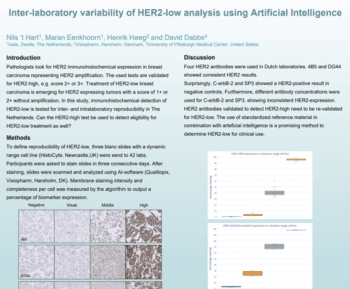
Yeah. So we’ve, we’ve done some studies on that, and for instance, there was a study done in conjunction with Nordic QC on HER2 and HER2 low, where the histocyte cell lines were read, by humans only, and there’s a Nordic QC experts in a blinded way, or by, Qualitopix independently, and Qualitopix is very much, more sensitive to picking up these forced fail, errors.
Yeah. Cool.
Just in the interest of time, we’ll just keep responses, short as possible. We’ve got four minutes left, but try and get through as many questions. So, Colin, just how the reference material is actually supplied? Is that a microwave block, and how many sections would that provide? I suppose you can speak to it briefly.
Blocks, slides, three hundred. There’ll be sections from from I think the most we’ve heard is for over five hundred, but I think most labs are two fifty to three hundred depending on depending on who’s cutting them really.
Yeah.
And, Matt, then I think the next part of that question, so each lab will have their own optimized protocols.
Is the software set up to account for this or is staining, assessed as a fixed standard? So I think you can make a comment to that.
Yeah. So you would, kind of at the point of setting up all the topics, you would effectively, establish what your statistical baseline looks like, and then, set your acceptance boundaries based off of that. And if there are outliers, we’d flag those for you.
Yeah. Yeah. So if, lab is doing, standard protocol or done a variation, it’s really on them, and we can actually, I think, record as well on Qualitopix. So if somebody changes their protocol, changes their clone, etcetera, whatever, that data is all held on Qualitopix and can be, can act as a point where people might see if there has been a variation and there’s then references to what might have caused that.
MAT as well, there’s also, other issues with running this as a separate control slide due to slide to slide variation. Speaker mentioned histoside blocks are compatible, but we are having issues on this as well. The low head two staining kind of comments started, but, if you can maybe talk about the, first point. So running them as, separate control slides.
What what do you mean by separate control slides? Is it like just the the, control?
Yeah. I think it’s in a workflow process, so using the kind of, cell lines from histoCyte and using that as a separate, almost a calibration slide, I suppose, I think talking in reference to slide to slide variation compared to the global, you know, impact of how the stainer is performing, I suppose. So I think there’s two different kind of methodologies that we talked about, and it’s referencing to that.
Yeah. So there’s there’s there’s, benefits and disadvantages of of of each.
For instance, with the, like, a blank slide, of course, you would have to, it’s a little bit more costly on the reagent side because you have to just kinda spend on dedicated reagents for for that run.
We have picked up a number of issues, for instance, to do with, I forget to mention that the bad reagent loss and a number of other issues across labs. So there’s there’s definitely value, in that this is running a parallel process in addition to your own, QC.
But to get the full, standardization, give you the best picture of where where you are, it it is best to kind of run it in every single predictive slide.
Absolutely. In an ideal world, I think you want it on every single slide. We also know it takes time sometimes to change methodology and, you know, process and all of that. So I think it’s good to have a first step option as well as, you know, using that as a kind of initial step to validate their status effectively at a it’s a good start point.
And gives gives labs that opportunity. They don’t have to go all in on it. It has to be used on every slide on day one. It’s something that can be built up to over time.
Just going through some of the other questions. So, in the case of PDL one s p two six three, will the software analyze individual core sections on the slide? For example, typical control for PDL one, has a, positive tissue sample, negative tissue sample, and a tonsil control. So, Matt, are you happy to talk to that?
So I got just got a text message unfortunately to a dash in a minute but would you be able to repeat the question?
Yeah so in the case of PD L1 SP263, will this talk about analyze individual core section on the slide? For example, a typical control for PDL one, for non small cell lung cancer has a pause positive tissue sample, negative tissue sample, and a tonsil control.
Yes. Right now, Qualitopix would would analyze your cell lines, or or your microglia if you’re using that. Right now, we do not analyze, tissue based, control samples on the slide. May maybe that will come, in the future, but not not, not right now.
Yep. Yeah. So I think it’s just to clarify to that user then, you would have cell lines as well in that regard. And, again, it might be something that, you know, using a single site to validate that stain on that stain on that date is a starting point, which identifies that, and they keep their, control tissue as described as is, referenced to at the moment. And then it’s something where the cell lines could be added to all slides in the future, depending.
Paul, I don’t know if you answered this before, but there’s a comment on the eMPR histoside controls having different staining strengths.
Anyways, I Yeah.
I just I just I answered that before, mate.
Was that the lengthy default?
No doubt. That was the lengthy answer I gave before.
Yeah. No problem.
Matt, I don’t know if you’ve got some time for this, but is there any consideration for providing Qualitopix for cytology staining as well? I guess that also depends on potential reference material.
It’s not currently on the roadmap.
There’s a sufficient market demand. Maybe it’s yeah. Maybe some, it’s worthy of a consideration for us. Mhmm.
Do we need to use, so one of the questions, do we need to use cell line for the use of color topics? Do you sort of use this to assess if a stain is reproducible for markers which only use a positive or negative control? I mean, I guess, Matt, do you wanna talk to the reason why we, you know, stipulate we want to use, you know, cell control? I think we’ve kind of commented on it, but if you want to just add further to that.
So, of course, there’s something Alright.
Colin, go Maybe I’ll be interested in the call and if you have anything else to add.
But we see that is actually critical. And just the positive and negative, you wouldn’t be able to see some of this the the sustaining adjustment changes, that you see, for instance, in the low or the mids.
Of course, for for for assay where, the true positives and true negatives are super far apart, you’re you probably don’t need that dynamic range. But, Colin, I’ll hand over to you.
Yeah. Look. I I think it depends on the tissue. I mean, the normal tissue is used because it’s normally more, reliable, but, it’s not always the case. And and the the tissues themselves, as I already mentioned about, the heterogeneity. So if you if you wanna use an absolute standard, then this is why we use the star lines because the the they’re formed in this kind of material so it should always be the same. Whereas you know you’re still getting through the tissue you get variation potentially just through you know protein heterogeneity and the question you have to ask is is the assay wobbling or or is my tissue, variable?
So you’re adding another variable to to, a bag of variables, and we’re trying to standardize it. So I think that’s why, you know, you could use tissue, but then you have this is always going to be a question in your head when you’re reflecting on results, I suppose.
That’s how I would look at it.
Yeah. And, no. I think I think it’s very valid point, Con. So thanks for adding that.
Someone’s asked if Qualtop can be used in a lab with a high workload and time issues. So, yeah, I’ll take that as a kickoff map, but you can add to it as well. But, mean, we have customers that are what you described as high workload labs and utilizing this. So I think there’s two sides to this.
Again, it depends how the lab is going to deploy the solution. So if we are talking about a lab that is looking to do this with a stage one kind of and validating as Matt described, their stainer. So they might be looking at doing a single slide per day per stainer. You might be even in a large lab with tens different stainer, you might be looking at adding ten extra slides per day for scanning and the upload time on that for the analysis.
So, really, it’s not a huge amount of workload. It doesn’t add a huge amount of time in user work. I’d rather say that because so you’re not you’re not expecting to add a lot to this. If you’re usablizing it in, the batch kind of processes we described, which is the ideal where we want to get to to validate every patient slide that comes through, then obviously, you would already have the cell lines on those sites. You would be staining those.
Ideally, they will already be digitized as part of your digital workflow in your lab. And what we will do is we will then take those images, and we will siphon them off as well, and we will analyze just the cell lines. So I just wanna be very clear. We won’t be analyzing any of the patient tissue in that case. It will be purely the cell lines.
Matt, just a comment as well from that as well. Maybe if you could just describe, quickly, kind of the you know, if I was to upload a, image today of some cell lines, what’s the kind of time frame that you’d be looking at kind of to get the analysis and get some data back? You know? Just because, again, I know people don’t have experience with AI, so a lot of people’s fear is it’s going to take an hour to do anything and analyze because of all this. So could you maybe just comment on that quickly?
Not at all. The analysis time, depends on kind of which marker we’re analyzing, but the average, is around two two to three minutes. So it’s the you’re gonna get results pretty, pretty swiftly.
Yeah. I think that’s important for people to be aware it is a very dynamic solution. You will get data back as soon as you’re uploading those images, really within or within a very short time frame. And, again, gives you an opportunity to capture some of those issues that might be occurring and instead of having to go all the way back through the workload of the week before, you might capture them a little bit quicker.
Someone says if you use tissue for your controls, this isn’t, for you unless you switch to cell lines. Is that the case?
I mean, we just discussed that, didn’t we?
In terms of Yeah.
Yeah. The the cell lines lend themselves as as part of that standardization, commission. I know, you know, some people want it to be used on tissue.
Yeah. I mean, I guess, Colin, just to add on that. I mean, how was the use of cell lines, you know, would you say in in the UK and and maybe elsewhere globally?
Well, well, we, is it I was looking at this the other day. So I think last year, we we sold, or or our controls are used in around about fifty to sixty thousand HER2 tests in the UK, and and globally, that’s probably just under three hundred thousand HER2 tests. So given the amount of blocks we sell and the the number of tests you get from it. So they’re pretty widely adopted.
Yeah.
It’s gone.
Yeah. Matt’s gonna have to pick up. I’ll get back.
So there was a, a question there about, EQA scores. Do you do you guys know with me?
Matt, I don’t know if you can comment on this is if anyone’s been able to give us any data yet back about if using Qualitopix has improved their EQA scores. Are you able to make any comment to that?
I had a few, I had a few examples of that. But, yeah, we’ve had labs that, for instance, went from poor to optimal, since using Qualitopix, but this hasn’t been a peer reviewed study since it’s more anecdotal evidence, at this point.
Yeah. And, Gordon, just for my own interest and stuff as well, I suppose, I mean, for satellites, could you submit them as part of the UCAS kind of assessment and for the AQA? Is that possible?
Yeah. So so people submit them, to Nicholas and Northern QC. I know with NECAS, we often get told that you can’t submit cell lines. You can, but what NECQUAS want to see is is tissue, even if just one piece of tissue. So it’s because they want to see the performance from the lab. They wanna see the quality of the the tissue that’s produced in their laboratory.
So having, the then they sample of tissue on there allows them to to to do that. So that’s the only caveat.
Yeah. So that’s a good point. I know someone’s commented that they submit cell lines as well already, which is is great.
Someone’s also asking about cell lines for h and e.
So, Matt, I don’t know if you want to comment to that a bit more. You’ve been involved in the kind of, alpha testing, I suppose, of the h and e assessment we’ve done.
So with that one, we’re, we’re actually working with NPIC in Leeds. They developed this tissue mimicking biopolymer for HME, but that’s very much a color control to look at kind of the the color shift in in in HME. And, yeah, potentially, we, we may may may be able to introduce something else on cell line, standard line.
And this is the starting point.
Yep.
I suppose, otherwise, Colin, there’s many of the markers and cell lines that could be, could be utilized otherwise.
If not not HNE. There’s there’s many other markers that we could look at in the future.
So it’s, yeah, there is I mean, if if the cell’s staying for anything, we get asked for special stains as well, then then I’m sure you guys can analyze it.
I mean, we’re primarily focused on, I I IHC and and Yep. I think that’s the the big ones that that are coming out, five sixty seven will be, actually, toward the end of the year, beginning next year.
K. It’s some others besides.
Yeah.
And I suppose just for people to be clear.
Sorry, ma’am. So sorry. Just to say that currently Quala Topix is immunohistochemistry only. So we do chi sixty seven, ERPR, HER2, PDL one, and we’ve recently introduced, MMR as well.
So just for people to look at that. But we it it is a, dynamic project as well. It will add more markers as they become available. We’ll work with histocyanin cell lines, and what really the market tells us that they want.
But as we’ve described as well, there may be a future outside of IHC as well for Qualitopix for h and e, potentially special stains as well. So, again, I think it’s an opportunity for labs to consider this as, you know, an ongoing process that they look at across their market, but an opportunity to kind of start with certain aspects today. And it’s really interesting to hear everyone’s a number of challenges around the ER and PR and if we can help provide data against that support. And, again, it may be something in the future we can help with where labs are at and kind of some benchmarking work and be able to provide some information that might be of interest to people.
Because, again, often labs are kind of sitting in their own silo realistically and it’s, you know, how is it performing against other, you know, market? Is it something that you find that you’re the labs that are having issues are all using the same supplier, got the same lot? We could it’s very difficult to work all of that information out today. So it might be something that Qualitubix could really help with in the future.
So for those that are having chances of the ER and PR, I would love to have a a follow-up conversation with you all.
I think we we might get yep. Go on. Sorry.
Just we we have done that so there are sites where we’ve sent material and it’s been, normalized by color topics and we’re able to show you that the little three isn’t being able to get the same kind of, results as others.
And so we’ve then been able to use it to start, you know, root cause, investigations in their laboratories.
So I mean, it it really does lend even now, we are able to to lend it to to some The yeah.
We sell the control material, but if anyone has any problems, part of what we do is the services around helping laboratories to to to problem solve. And we’re doing more and more of that with and it means you guys because it gives us that kind of, hard for us data.
No. Absolutely. I think it’s, it’s a really good guide, and and especially as we see more and more labs as part of the pathology networks now, you know, doing cross site reporting and sharing slides across sites and moving services effectively or, you know, etcetera. I think it’s going to become even more and more important around standardization across networks as well and looking at that. So we can add more data to that, then that surely only helps with with decisions going forward.
I appreciate we’ve kind of we’ve run over a bit of time here. I’m really thankful to, the attendees. There’s still seventy three people, online. We had, highs of over a hundred and hundred and thirty, I think, at one point today. So thank you all for giving up your time today. I know it’s, always very busy in the lab, so really appreciate you, sparing some time with us. Also just like to thank, the speakers, so to Colin, to Matt for, being involved in this and hopefully real beneficial and interesting discussions with everybody.
We will be sending out an email at the end of this, session, so there’ll be an opportunity for anyone that’s been attending this event to, respond and say that they’d be interested to have a follow-up conversation with Visiopharm and HistoCyte about some of the solutions that we’ve talked about today. That might be, you know, a specific demo for your department with myself or one of my colleagues from Visiopharm, and really how we can address those issues, in your lab.
Also, if you’re, going to be attending, the UCAS event in Birmingham on the twentieth of September, we will be there. And, I know this event was kind of in collaboration with you with, UK NEQAS, so we’d, really like to thank, Andy for putting out the message out there, and, hopefully, it’s been really helpful for everyone. So, we would hopefully see most of you there as well. But, any of the questions, please do not hesitate to reach out to ourselves.
Really interesting discussions, and, we hope to speak to you all again soon. Thank you all.
Nice.
Thank you very much.
Cheers. Take care. Bye bye.
In this webinar, we will discuss the key challenges of IHC standardisation and you will be introduced to Qualitopix, an innovative solution that can be coupled with UK NEQAS ICC & ISH’s rigorous four-monthly assessments, enabling end-to-end quality assurance monitoring.
Learning objectives
- Understand the key challenges around analytic standardisation in immunohistochemistry (IHC), along with their root causes.
- Learn about Qualitopix, a practical and novel QA/QC solution for measuring analytical performance daily (including staining consistency) in IHC.
- Explore real-world examples and use cases of Qualitopix implementation in laboratories.
- Gain insights into regulatory changes and how Qualitopix can help meet these requirements.

Mateusz Tylicki, Product Manager at Visiopharm
Mateusz Tylicki is a dedicated AI Product Leader with a focus on Life Sciences and Healthcare. He is currently a Product Manager at Visiopharm, where he leads the development and validation of Qualitopix. In this role, Mateusz heads a multidisciplinary team committed to enhancing quality control and assurance in labs through AI technology. With over a decade of experience, Mateusz has held key product management roles at companies like Kheiron Medical and Antidote.me. His work has consistently centered on leveraging technology to improve patient care. He also served as a Product Management TA at General Assembly, helping to educate and mentor aspiring product managers. He holds a degree in Biological Science with Honors in Pharmacology from The University of Edinburgh and a Product Management certification from General Assembly. Based in Amsterdam, Mateusz is passionate about using AI to advance healthcare and improve lab operations.

Colin Tristram, CEO at Histocyte
Colin has spent the last twenty years developing, marketing, and commercializing a range of products for the IVD market, specifically tissue diagnostics. Colin is the founder and current CEO of HistoCyte laboratories. He studied Medical Microbiology at Newcastle University, specializing in immunology. His MSc focused on HER2 in breast cancer, involving the development of procedures for IHC controls. With this knowledge he and his colleagues started HistoCyte and developed a range of high-quality, reproducible, and cost-effective analyte control material for same-slide use in histopathology. HistoCyte was acquired by Atlas Antibodies in 2021.