
Transcript
Alright. Hello, everybody. Welcome to another master class.
My name is Leticia, and today with me, I have doctor Nils ‘t Hart. He’s a pathologist at Isala Hospital in the Netherlands.
And today, he’s gonna be presenting a study on interlaboratory HER2 variability and daily quality control across multiple Dutch labs.
I invite you all to stay to the end of this lecture because there will be a chance to ask questions to to Nils. So I encourage everyone to stay and engage at the end. I hope you enjoy this class. So let’s get started.
Hello. I am Nils ‘t Hart, a pathologist in the Netherlands.
I would like to thank the organizers for the opportunity to talk to you about the study concerning interlaboratory HER2 variability.
Furthermore, I would like to address a new approach to a daily control of immunohistochemical stains.
My disclosures, I’m a pathologist at Isla, a general hospital at Zwolle, and that’s in the center of the Netherlands.
During this session, I would like to discuss our study concerning HER2 immunohistochemistry.
We focused on HER2 low and showed the anti laboratory variability of the stain.
I will address the use of calibrators and cell lines, what we learned from the study and what we can do to improve.
I’m also going to talk about AI assist its quality controls and I’ll propose a testing algorithm that might be feasible in daily practice.
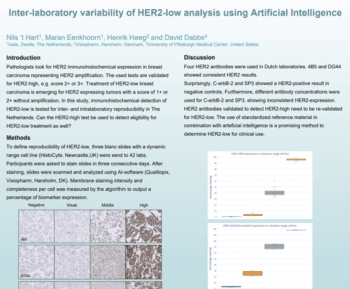
The study we did focused on the performance of Dutch laboratories concerning HER2 analysis.
We all know that we have been scoring HER2 for years now. However, we validated our test and are used to scoring in order to detect HER2 amplified breast carcinomas.
The protocols we use are meant to fight HER2 with a three plus score.
We designed the study to evaluate how our scoring performance looks like when we are using the same technique for a different goal.
I considered it likely that scoring of HER2 low will be different compared to scoring to detect HER2 amplifications.
Forty Dutch laboratories were invited to participate in our EQA like study.
We asked the labs to stain three blank slides on three consecutive days. We explained that we were looking for HER2 low and asked them to use their routine protocols for HER2 staining.
The blank slides all contained a calibrator using microbeads to allow calculation of the lower limit of detection.
Use reference material that is standardized and uses traceable units of measure.
The calibrators have been addressed previously in this master class series. I nevertheless would like to explain them briefly again and show them to you, hoping it will help you to properly understand the study we did.
So, the calibrator is made with fifteen spots containing ten spots of coated glass beads ranging from thirty eight thousand to two point seven million copies of Neur2 protein.
The exact concentration was measured using a fluorescent signal that is equivalent to the number of copies.
Then calibrated spots contained on fixed beads, three more spots contained formalin fixed controls, and the two spots contained blank beads.
The photo in the upper right corner shows you stained, unstained beads, and the smaller ones are the colored standard beads.
The blank slides we shipped to the labs also contained a so called dynamic range saline.
We included a saline as we considered it to be informative to pathologists as we are more used to looking at cells and tissue than we are used to looking at the microweeds.
Furthermore, a cell line is more easily available and sometimes already in use in labs.
We ask the participating laboratories to return their stained slides for central analysis.
This slide shows you a schematic overview of the cell line. We used the cell line with four spots, containing a negative, weakly positive, intermediate positive, and a strongly staining cell line core.
These cores represent a HER2 negative, HER2 one plus, two plus, and three plus tumor.
Before we go to the results, I would like to walk you through some schematic drawings we consider to be relevant.
First, I would like to show you a graph published by Thunessen et al.
This schematic view shows you relevant and irrelevant areas in the sigmoid curve showing epitope concentration and staining intensity, the epitope concentration on the x axis and the staining intensity on the y axis.
A clearly negative or clearly positive case is not very informative when you are validating a new stain.
The entrance ring area is the nardamic range in the sigmoid curve marked with the green bar.
This is the most informative area on the curve, the so called critical samples.
For example, if you use a TMA with several different tumor cores, it would be ideal if your TMA contains tumor showing staining patterns in this specific area of the curve.
The right side of the slide shows you a similar schematic graph. We tried to include a calibrator and later the saline.
We know exactly where to draw the calibrator spots, the negative cell line core, and the clearly positive cell line core. Unfortunately, we are not completely sure where to place the weak and the intermediate cell lines.
Using this schematic representation of the slides, we consider this to be the dynamic range.
And the cross represents the LOD.
These three spots are negative spots on the calibrator. Only a few are required to validate the immunohistochemical stain.
The LOD is the spot where slightly positive samples are found. I I consider that to be ideal if a calibrated spot is just above the LOD.
Furthermore, it would be great if the weakly staining cell lines is just above the LOD as well. However, we are not completely sure where to position the second core of of the cell line exactly.
This is the most informative area showing you the linear range.
Most variation in HER2 is found here and corresponds to the intermediate core, the two plus core. Finally, the plateau phase is reached. Again, just like the clearly negative spots, only a few samples are required for validation of an essay.
This graph shows you the results concerning the low limit of detection.
Nineteen labs used the antibody 4B5, also called the pathway test.
Six labs used a zero four eight five.
Five labs used dt44 or the intercept test. And five more labs used sp3.
On the y axis, the LOD.
And please remember that the study showing a benefit for tastuzumab directtokam ADC treatment used four b five in combination with the ultra fuel detection method.
When ultra view detection is used instead, the LOD is slightly lower. Thus, the test is becoming more sensitive.
Variation for four b five with ultra view detection seems considerable.
That is something that is known. The LOD of s p three is quite high, and that one also shows significant variability.
I would like to briefly touch upon the analytical response curves.
On the x axis, the epitope concentration is a number that is equivalent to the fluorescent reference signal times one thousand.
On the y axis, the measured staining intensity.
And this graph shows you the four b five results.
The next one, dg forty four.
And the last one is sp3.
Dg forty four clearly eats his strong expression of HER2 early, and sp three remains when it’s weakly positive for a longer time period.
Please note that the fourth antibody, that is a zero four eight five, is not shown here.
The calibrator results were inconclusive due to a strong background staining.
The similar results were found in the cell lines.
In these graphs you can appreciate that the DT44 antibody is getting positive before 4b5.
It was surprising to me that s p three and a zero four eight five showed a positive result for the negative core, rendering these antibodies less suitable for detection of HER2 low.
These examples show you the four cores of the cell lines and how they look like. If you like, you can review the course yourself on the website I will show you during the discussion session.
So what does this miss mean for daily practice?
We detected considerable interlaboratory variability for HER2, an issue that needs to be addressed.
We should redo validations when a different clinical question is asked.
HER2 measurement to detect amplification is a different question compared to HER2 low scoring.
We also should check for predictive image to chemical stains for consistency over time. I did not show the data. We nevertheless measured the variability between three consecutive days as well, and that proved to be significant.
I would like to suggest an algorithm for HER2 detection to simplify our daily routines.
The idea is that we should try to imagine to which spot the stain results correspond on the previously shown curves.
Doing so allows you to simplify interpretation.
When can you be satisfied with the result and when do you need to redo the stain?
For example, if the control looks good and the tumor is clearly positive, you can go ahead and score the tumor.
Also, if the control looks good and the tumor is negative, check the control using AI.
If the results are within limits, you can continue scoring with or without AI assisted scoring of the tumor.
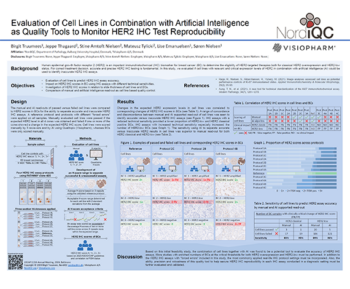
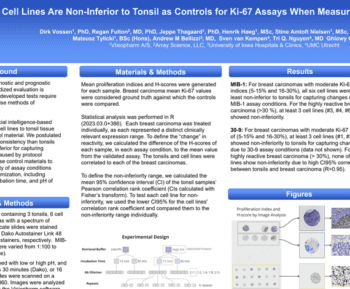
Measurement of the cell line in Qualitopix allows an exact measurement and allows calculation of the mean and cut offs. So Qualitopix can be used as AI assisted scoring of your cell line controls.
Repetitive measurements makes it a lot easier to demonstrate stains that are outside its detection limits.
Issues can be detected easily.
Some issues were difficult to detect by eyeballing, nevertheless were found easily in Qualitopix . For example, on one day using OptiView detection, one slide showed a very strong signal.
Another slide stained on the same day in the same machine, but stained with UltraView detection did not show that different expression level.
The use of an online program is sometimes classified as a potential privacy hazard.
I had to discuss that issue at our center as well. To overcome that issue, you need a service level agreement with the vendor of the online tool.
It is now possible to use scans from a manual scanner instead of a box scanner that are normally used for digital pathology.
This manual scanner is easy to use, cheap, and can be of value to overcome GDPR issues, or for labs that are not fully digitalized yet.
In this graph the differences between both scanners are shown for the cell lines. These results show slightly differences, meaning that it’s not possible to use both a bulk scanner and a manual scanner for the same goal. You do need to make a choice between both.
In conclusion, HER2 needs revalidation when you would like to use the test for detecting HER2 in amplified breast carcinomas as well as HER2 though. Four b five and d g forty four show consistent results, and the detection method used does matter.
AI assisted quality control can be very helpful to detect faulty machines or stains early.
The use of an algorithm might help to choose wisely if you need to redo the stain or not. This algorithm can be very helpful to decrease the additional workload for your lab technicians.
AI assist quality control is feasible with both automated bulk scanners as well as manual scanners.
Thank you for your attention.
Hello, news. Thank you for this great presentation.
I’m gonna ask you to turn on your video camera now for us and your microphone so we can start the q and a?
Yes. Thank you very much. Hello.
Hello. Hi.
So, yeah, should we start with the questions first, Nios, or you wanna share Yeah. The cell lines and calibrators that you wanted to show? Up to you.
Maybe that’s a that’s a good start.
What I intended to do was to demonstrate, some slides, to show you the calibrators and to to show the cell lines and the differences. You you can appreciate them there a bit better than in a PowerPoint. This is the website I would like to to use to demonstrate, the slides.
And here you can see the calibrator slides and below that cell lines.
Let’s first start with the the calibrators.
I hope you can see them now.
Yes. We can see.
These are the fifteen course I talked about, starting with the first one in the upper left corner and then the last one at the right side. So if we have a look at the first one first, you can see the calibrators a bit better than on the photos.
It’s it’s about the larger beads. So you have two beads in this slide, small ones, which are the color standards and the larger ones. This is an unstained bead.
And if we continue to follow to the next one, it’s still not showing any staining here.
When we arrive at the third bead, you can see there’s slightly a slight difference compared to the negative ones.
But then that becomes a bit more clear if you continue this path to the fourth one.
And now you can see a few slides that are clearly positive. For example, this one, and the other ones also show us a bit darker rim of the of the beads. The color standards remain the same, of course.
So if we cross to the other side, there are the strongest staining beads.
For example, this one, now you can clearly see that there’s a positive signal.
So going back to number four, I think this is clearly a positive. You have to look for it, but it’s about the LODs or the lower level of detection.
And if we go back to the third one, I think it’s still a bit present here. For example, that beat.
So you are somewhere at spot three that you can see the the staining, appearing a bit. So this is, in fact, used to draw the sigmoid curves that I showed in the presentation.
So we have an additional one. This is a clearly negative negative one. This is a negative as well. And these three in the middle are color standards as well, not really a calibrator, but more like a control which which you can use for a daily practice since it’s it’s now a reference to the calibrator, but not showing gradual increase in staining intensity. It’s just a bit more clearer than the calibrator itself.
So that’s about the calibrator. And when we now switch to the cell lines, for example, this one, they were on the same glass.
This is a clearly positive, of course.
And then we have the two in the middle that are a bit more difficult. It’s still clearly positive. What you can see is decreasing in intensity.
And then the last one is the negative one.
So if you keep this in mind, especially this score or the third one, and we can switch from the staining of four b five cells to the d g forty four. At this this slide, you can now see that it is a bit stronger compared to four b five.
So the probably expected LOD is a bit lower as well, and that’s exactly what we found.
So these kind of cell lines and beats, were measured exactly using digital pathology, and the cell lines were used in Qualitopix . And, that figures, and that that percentages that you can get back from Qualitopix are used for the study.
Alright. So now everyone had a chance to review the calibrators and the cell lines.
Maybe there are some questions.
Yes. Thank you. Thank you for sharing this news.
We have one question from Mas. He’s well, first of all, he’s saying thank you for the interesting talk, and he wanted to hear how can you ensure that cell lines express the same levels of antigen over time.
Well, that’s that’s an interesting one. Thank you for your question.
You really cannot make sure that it’s exactly the same. That is what you assume. Right? So what you do, in fact, in in your daily practice is repeated measurements.
So you measure your cell line not just once, but I will suggest at least twenty twenty times, then use Qualitopix to measure exactly where your levels are during that twenty or during that period you measure those twenty slides.
So if you plot that in a graph, and that’s the so called graph, you can see exactly the differences over time.
And that’s the interesting part. So if you have those twenty results, you can, draw the mean from your results and the standard deviation and use that to to yeah. As a some kind of calibration for that specific, marker.
And the next step would be maybe a few days later, if you do the stain again, that you check your result compared to the previous results and check if you’re still in the right limits of your detection on a on a limit of detection for that specific marker.
That’s that’s the idea. And my experience is that cell lines look quite good and quite stable.
Sometimes had to question if it’s still correct, and I changed it using another cell block and discussed it a bit with the vendor of the cell lines. But, well, they always prove to be quite stable. Also also, if you use them after you store them a while in the freezer or on your well, maybe even on the desk, it’s still showing quite a good result.
So that’s that’s how we work with the cell lines.
Alright. Thank you.
We have a question from Bettina. She’s asking, how does Qualitopix help you to decide which things should be repeated?
Yeah. That’s about the same. So you first start, measuring those twenty initial samples.
And if you are happy with those samples, you can call them, okay. This is my my gold standard.
I did that gold standard for twenty times, calculated the mean and the standard deviation, and that’s that’s your that that’s the setting of that specific marker in your lab.
Each lab should do that for themselves. So there’s always a bit of a difference between labs, and also between days. So it’s not an exact number that you are going to get. It’s it’s an estimate for that specific day. As long as it’s between limits, it’s probably going to be fine.
So I of course, we tested that and used some slides that are not correctly stained, so with another antibody dilution or with another thickness of the slide itself. And then you quite rapidly see it’s changing.
So slight changes can be detected in this way, but you have to calibrate your call topic setting first, of course.
Okay. Cool. And you mentioned on the conclusions that by using AI or, in this case, Qualitopix, it helps to decrease the workload in the lab. Could you elaborate a little bit on that?
Yeah.
Well, it’s always getting more work, of course, if you have to do it that way.
And I was looking for a way how to diminish that workload for your lab technicians.
And so they already have a lot of work to do. So are you going to do it yourself? Well, you’re probably busy as well. So what to do then?
Well, I found it quite time consuming to scan the slides with our routine scanner, download the slide, and upload it again to Qualitopix.
Yeah. Of course, you get a fine result, but then it’s taking quite some time and sometimes miscans.
So I was looking for other methods, other scanners, to to find out if that might be a bit easier.
The last summer, I was at the, ECP meeting in Dublin and found another tool that I found very promising.
Maybe I could show you that.
Is that okay?
Yeah. Yeah.
Yeah.
Alright. So I show you a little video.
It’s a it’s a new video, and I’m using a so called manual scanner.
You show us a slide in the presentation about that.
I just let it run and talk a bit meanwhile.
So this scanner, I’m now scanning the the the cell lines. Obviously, I’m starting with the the strongly staining cell line, and you can see, a little grid. There’s a circle on that. And the idea is to use that grid to capture the, the slide image.
And I’m now recording the tissue and make it, well, some kind of a whole slide image. Now skipping to the next one, it’s also the idea to find, the circle and display the, the tissue in exactly that circle, then continue further to the third core of the cell line.
Record that as well.
That’s what’s happening now. Sometimes it’s not really in focus, so you can adjust it a bit, or go back in the in the slide and do a second recording, and and that’s all done during this process.
So now you can see that I’m almost finished scanning the four course, and that’s that’s it. It doesn’t take a lot of time.
It’s done now, in fact.
So using this, this scan in fact, it’s whole slide scan, but just skipping the blank parts of the slide that was good enough to use for Qualitopix. So I made the scan, uploaded that, to Qualitopix, and, well, it’s a small it’s a small, file, in in fact, so it doesn’t take that long and waited for the results before you continue scoring the slides. So you don’t need to go to the scanner. You do it yourself on the on the microscope.
And, well, it proved to be quite easy.
So I’m quite happy with that improvement, and it works.
It’s maybe surprising, but it does work.
Very nice.
Thank you for sharing.
We just got another question.
Let me see.
What are the most important things to check for consistency?
Are all IHCs things important, or are there some that are more sensitive to low high variability like HER2?
Alright.
Yes. That’s that’s an interesting one. I’ve been thinking about that as well.
And the idea behind this is is, sometimes we use stains in a panel. Right? So we don’t just look at one stain. We use a panel of stains probably containing positive of expected to be positive stains or negative stains all in the same panel.
So if you are working in a in a panel like setting to determine a diagnosis, I don’t think you should of your need to do this. You can, obviously, but it’s not really needed since if one slide is off and not correctly stains, you will still detect the right, and the right amount of stain that you require. If a strong positive stain is expected, it’s it’s weekly positive. It’s still positive, so who cares?
In fact, it’s getting more important if you use just one stain. For for example, if you use a stain to determine if a patient is eligible for a specific treatment choice, then you don’t have the control with the other stains. It’s just that one slide that you need to score.
So that’s the one I find to be important. So if you would like to score HER2 or if you would like to score EDL one, for example, those are just single stains used for just one go, and that’s the treatment decision.
So that are the stains that I would like to advocate to use in a system like this.
And, well, to to be fair, not a lot of stains need to be scored exactly in in systems like they’re gonna Qualitopix tool. So that’s that’s the algorithm I showed.
So some of them are clearly positive, so you, well, might not need to scan those and upload those slides. It’s just about the ones that are negative or possibly around the cutoff, that is clinically relevant. So if you just use those to scan them, check the controls exactly, and then use AI to measure the tissue, that’s probably good enough.
Cool.
Thank you.
Henrik is asking, you used both cell lines and beads in your study and have shown a correlation between the material.
How do you see yourself using these materials in the future?
Will you use them both?
Not sure yet if if I’m going to use both.
I will probably continue using the calibrator first just to make sure that that the tissue and or the the stain is exactly right and exactly stained correctly.
And that’s the first step, but that’s a very cumbersome tool to use for everyday, diagnostics.
You cannot use a calibrator and calculate your LOD for that specific day again and again. So you do that once, and then you you switch to not maybe not the use of a calibrator, but of, the control beads.
And when you choose a control bead, for example, that is quite near your LOD, so, for example, in the one I showed you before, spot three was slightly staining, and spot four was a bit more clear compared to spot three. So one of those, you can use that one for your daily practice. If if that beat is slightly staining in in the case you would like to score, then you’re probably safe and and you can continue.
The other thing is, cell lines are quite useful as well.
So if you used that, maybe ask your technicians or do it yourself like I showed you before.
Then you have also a good idea if you are in the right area with the stain intensity.
So those two would be important. The beads controls with just one spot or the cell lines, Maybe one of them that that you prefer, but I would advocate to start with the calibrators just making sure that you are in the right area with the lower level of detection.
Cool.
Okay.
Thank thank you.
I think that’s it for today.
We don’t have more questions, but I wanna say thank you, Nils, for the very interesting presentation and very nice of you to, you know, share your screen and show different things. I think it’s always interesting to see different stuff. So Alright. Yeah. Thank you. And very interesting study as well with Qualitopix.
So Thank you very much.
Okay.
Yes. Bye bye. For coming. And yeah. See you. Just everyone, also, I wanna say thank you for joining the master class.
Thanks, Nils. Thanks, everybody. Bye.
Bye bye.
In this lecture, Dr. Hart will present a study on inter-laboratory HER2 variability and daily quality control across 40 Dutch pathology laboratories. He will explore the use of calibrators and cell lines, emphasize the importance of revalidation of HER2 tests, and discuss the advantages of Qualitopix as an AI-assisted tool for detecting staining inconsistencies in laboratories.

Nils ‘t Hart, Pathologist, Isala Hospital, The Netherlands
Nils ‘t Hart is a thoracic pathologist with a position at Isala since 2009. Isala is a top clinical hospital in the center of The Netherlands. Since Nils finished his residency at UMCG, he is focusing on diagnostics in thoracic pathology, molecular diagnostics and predictive immunohistochemistry. He is interested in new developments in oncology, how to implement predictive markers in daily practice using AI and eager to do pathology research. Last but not least, he is always looking for new innovative methods to teach about his passion.