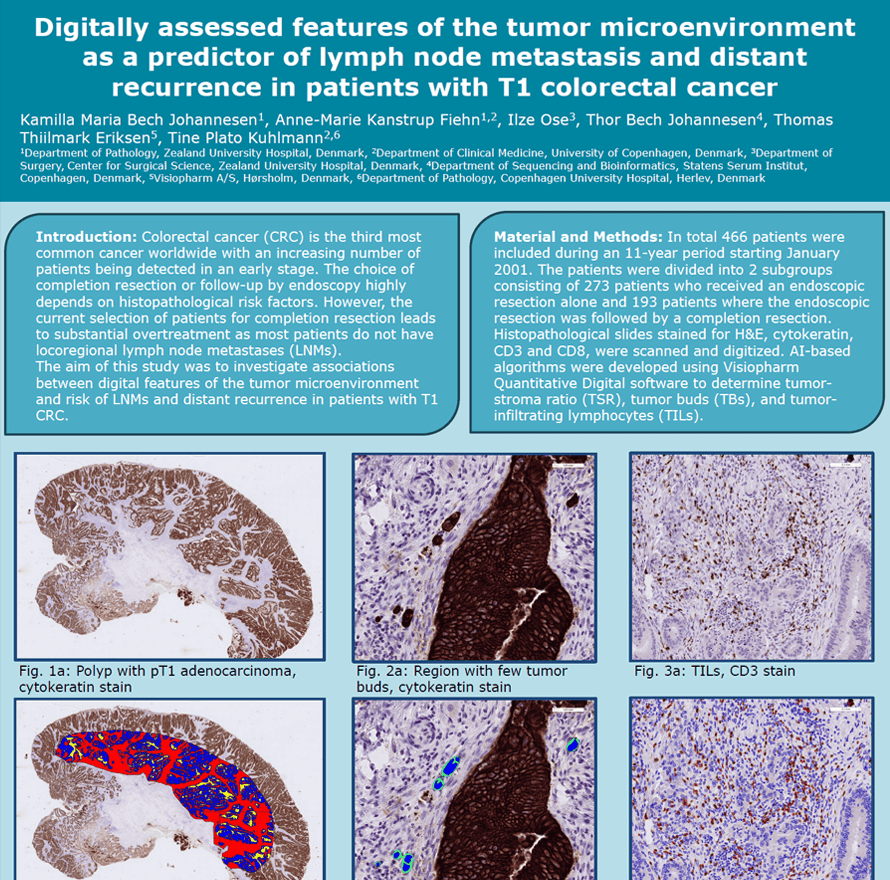
Digitally assessed features of the tumor microenvironment as a predictor of lymph node metastasis and distant recurrence in patients with T1 colorectal cancer
This scientific poster presented at ECDP by Zealand University Hospital explores how AI-driven digital pathology can improve risk prediction in patients with early-stage (T1) colorectal cancer. Accurate identification of patients at risk of lymph node metastasis remains a major clinical challenge, often leading to overtreatment with unnecessary surgery.
The study investigates whether digitally assessed features of the tumor microenvironment—including tumor budding, tumor-stroma ratio, and tumor-infiltrating lymphocytes (TILs)—can provide more precise prognostic insights. Using a cohort of 466 patients, advanced image analysis algorithms were applied to digitized histopathological slides to quantify these features objectively.
The results demonstrate that a high number of tumor buds is associated with an increased risk of lymph node metastasis, while low levels of immune cells (CD3+ and CD8+ TILs) are linked to a higher likelihood of distant cancer recurrence. These findings highlight the potential of AI-based image analysis to complement traditional histopathological risk factors.
By integrating computational pathology and machine learning into clinical workflows, this research supports the development of more accurate risk stratification models for colorectal cancer. Ultimately, the approach may help clinicians make more informed treatment decisions, reduce unnecessary surgical interventions, and improve personalized patient care.
This poster is relevant for professionals in pathology, oncology, digital health, and medical AI, offering insights into how quantitative image analysis can transform cancer diagnostics and prognosis.
Kamilla Maria Bech Johannesen1, Anne-Marie Kanstrup Fiehn1,2, Ilze Ose3, Thor Bech Johannesen4, Thomas Thiilmark Eriksen5, Tine Plato Kuhlmann2,6
- Department of Pathology, Zealand University Hospital, Denmark
- Department of Clinical Medicine, University of Copenhagen, Denmark
- Department of Surgery, Center for Surgical Science, Zealand University Hospital, Denmark
- Department of Sequencing and Bioinformatics, Statens Serum Institut, Copenhagen, Denmark
- Visiopharm A/S, Hørsholm, Denmark
- Department of Pathology, Copenhagen University Hospital, Herlev, Denmark