HOST-Factor: Unveiling pancreatic cancer microenvironment neighborhoods through highplex imaging and spatial profiling
Transcript
Welcome everybody to our newest edition of the Spatial Biology Masterclass.
Today we have with us Janusz Franco Barraza.
He’s a research assistant professor at the Kuckelman Lab and manager at the Spatial Immunoproteomics Facility at Fox Chase Cancer Center in Philadelphia.
Today he will talk about how he’s using highplex IF microscopy with Visiopharm’s Phenoplex to generate spatial distribution data identifying potential tumor promoting or suppressive neighborhoods.
And for that I give over to you Janos.
Thank you.
And I have to say it’s a pleasure to be here again sharing the, steps that we are, following to start, analyzing these these, microenvironment in the tumor, which is the hot topic in biology now. And let me start sharing my screen.
Alright.
Well, as Bettina already mentioned, the the title. So, yeah, basically, I want to introduce you guys the host factor and how we are planning to use it for screening and scoring the stroma of, solid tumors. In particular, we’re working right now with pancreatic cancer.
But let me start with, details.
So first of all, I have no financial relationships to disclose, but I’m a consultant of alpha and beta products for, LUNA four technologies and, of course, for, Visiopharm.
So I would like to start talking about the budgets, seed and soil theory, which, basically, was telling us that in order for, cancer cells to thrive, they need to be in the right microenvironment, hence the right soil for this seed to to grow.
So we know that normal stroma has natural, tumor, tumor suppressive properties, and everything goes in balance until it’s not. And when that happens, this soil becomes very fertile for cancer cells.
And then when is when we can, call it tumor promoting a stroma.
Well, our duty in research is to understand how is this happening to provide the clinicians with the right tools, the right targets that we can attack either to prevent this from happening and never let the, the soil to become fertile, or the opposite when we have already, cases when the the stroma is tumor promoting, how to tune it back, to turn it into a tumor suppressive stroma.
Well, so in order to understand that, we are working with one of the most, I will say, stromal rich, tumors, which is pancreatic cancer. And as you can see in this image, is characterized by a dense fibrotic stroma, which is a picture here in teal, which is surrounding the, cancer cells picture here in yellow.
And as you can see, the ratio is overwhelming between stromal cells versus actual cancer cells. So imagine now that the if this, tumor microenvironment is fertile, how, these cancer cells will be thriving?
Well, in order to understand, these, dynamics, we are focused on studying the cancer as a associated fibroblast, which is the major stromal component of this microenvironment.
But not only the cells, also their own extracellular matrix, which in turn, they form the CAF units. And this is how we are, studying the biology of of these entities.
Needless to say, the pancreatic cancer is a rising threat, and is has been predicted to become the second deadliest cancer by twenty twenty six. So therefore, we have to really pay attention to this malignancy and, conduct our research to prevent this from happening.
Our lab, as I mentioned, has been focused on understanding the CAF units since several years ago.
So we have been, studying the biology from different aspects, and what I want to show you right now is a summary of some of, the the discoveries that we have made and how we are using those now to, practically understand better the, tumor microenvironment.
So what you can see here is, our beginnings doing multiplex staining. So I remember at that time, we were having probably seven or eight markers. That was the maximum that we were able to to detect, with a very, simple jet efficient code that you have here, the link to. So we were able to start gating amongst the cell populations based on the expression of markers.
This is the early times of, but later, Visiopharm is able to to, provide us. Okay. At that time, we started to understand that the normal, microenvironment on, possess certain characteristics as opposed as the tumor associated microenvironment. And amongst the tumor associated microenvironment, we found that we can recognize two different, phenotypes, the tumor suppressive or the tumor promoting.
And in this case, just pay attention to the intensity of this marker, this, alpha five beta one integrin in green, which is overwhelming, appearing in the tumor promoting versus the tumor suppressive.
So at that time, we already understood that the tumor microenvironment of pancreatic cancer had an increased, organization of the ECM fibers, also called anisotropy.
We detected augmented, TGA beta signaling in the fibroblast of these environments.
And we also, found, particular, calf extracellular matrix, interactions. These structures that were having a particular signature.
So we corroborate that these are, bio clinically relevant because we found that, when we were having this tumor promoting phenotype more abundant, so, retrospectively, our patients were, perishing faster than those that didn’t have this particular phenotype.
Well, our, research continue, and now we also pay attention to the characteristics of the cytoskeleton of these cancer associated fibroblasts. We found, for example, the expression of particular, acting remodelers as palliding, and particular isoforms like three and four. And, along the talk, I’m gonna be referring to the isoform three, which is the one that we found is, highly expressed in a tumor promoting, microenvironment.
Recently, we also found the expression of unique, proteins that normally are, expressed in the in neurons. And it was a surprise to find them, in the cancer associated fibroblast of pancreatic cancer. This is the case of an nthrin g one. And we found that the stroma of pancreatic cancer, patients with high levels, as you can see here, of, netrin g one, were, desisting faster than those that had less levels. Also, we found that the cells can secrete extracellular vesicles, and the profile of these extracellular vesicles is very, unique.
They, normally have low levels of alpha five beta one integrating the surface and high levels of net ring g one. So combining all these, features, we came with a simple yet, comprehensive signature to define, what is a tumor promoting versus a tumor suppressive functional status in cancer associated fibroblasts. And just as a summary, I want to show you the tumor promoting CAF have high high levels of anisotropy, have, high levels of t g beta signaling, increased three d adhesions, high expression of acting remodelers, and a unique profile with low targets in the unique EVs that we are having, that I just mentioned.
But then we came with the question, okay, so these are basic findings. How can we put them this to work for our patients? Can we combine all of them and monitor the stroma of these patients?
So at this moment, it was, fortune to, find, for example, doctor Joshua Mayer, a clinician which is, working in the radiation oncology department and discussing with them, the the the new therapies that they are using, we found that he discovered that by using a particular modality of radiotherapy that is called pulse low dose radiation.
So the patients apparently were, having less side effects. How is this, connecting with us? Well, let me first explain. Low dose radiation, basically, is the same dose that we are, that patients are receiving for, radiotherapy, but instead of being, delivered in a single beam continuously, it’s being fractionated in micro doses and then is being, delivered in pulses. So between each pulse, there is a resting period.
So at the end, the patient is receiving the full dose that they’re supposed to receive, but, as I said, in pulses. What is this causing? Well, this triggers a particular biological, response where cancer cells, they still become radio, sensitized, so they are dying.
But cells that are not, cancerous, hence, for example, the tumor microenvironment cells, have a chance to recover from the insult given by the, the radiation.
And this was relevant for us because, as I said, this causes less toxicity in those organs that are radiosensitive.
And it happens that the most radiosensitive organs, are exactly in the gastrointestinal tract as, cancer as pancreasies.
And as you can see, this, microphotography, a very important player is TGF beta, which, is triggered. We know this. Normally, with radiation, cells start to produce TGF beta, but when, the tissues are receiving the radiation impulses, the levels are very minimal or on. So why is this relevant? Well, TGF beta, it happens to be a major driver of the fibrosis that is happening in the microenvironment of pancreatic cancer. So if we can tame the production of TGF beta or the signaling, so we have chances to modulate the stroma from tumor promoting to tumor suppressive.
And yes. Exactly. That is the question that we, voice. So is PLDR able to induce a tumor suppressive stroma or still is gonna induce a tumor promoting stroma? Remember, this is done in tissues that are normal tissues, are radiosensitive, but are normal tissues. Now the question goes directly to pancreatic cancer lesions.
For that, we, started by studying the CAF units in a model that we have standardized in the lab since several years ago. I’m not going into details of those, but you can find more information following these references.
So, basically, we are growing tissue derived fibroblasts that have been extracted from fresh biopsies from patients. We put them to grow and we, allow them to construct their own, CAV units. Once we have these three d cultures, now these are radiated with a combination of gemcitabine and either the continuous radiation or the pulse, low dose radiation.
This is aiming to mimic the total neoadjuvant therapy that patients are receiving in the clinic.
Once these cultures have been treated with these variations of radiotherapy, so now, again, we can start questioning the presence of these markers to start understanding better the cell responses.
And then after that, we remove the cells and we only keep the the bio scaffolds, extracellular matrices. Now we bring naive fibroblasts to evaluate the responses they are having to this alter, in favor of the patient or, in in detriment of the patient, matrices produced. So but let’s see the result that we found.
So what you’re seeing here is a staining of the extracellular matrix in these cultures.
And the color coding that you see here is basically the each fiber is color coded, based on the angle of orientation.
As you can see here, when these cultures are irradiated with the, continuous radiotherapy, you start seeing more of the, cyan color, meaning there is less variation in the tones, meaning the angles are mostly, following a certain degree. The degree does is not important. What is important here is that most of the fibers are aligned, are dense.
Imagine, these structures is, denser, and it gives more resistance that, environment that is a little less lax. Okay? So, as I said, we found that we have a, an increase in the, anisotropy when we are giving the radiotherapy, the continuous radiotherapy.
But when we are, giving these cells the pulse low, low dose radiation, so we see a decrease in this alignment, as you can see here.
Well, we took then the effects of the conventional radiotherapy as our standard to normalize our data and to start seeing variations when we are just giving the gemcitabine versus the combination with the poll, pulse load of radiation.
And as you can see here, when we follow either the t j beta signaling, at the TDF heat on the structures, the acting remodelers that I mentioned, or the, the presence of the unique EVs, in all cases, although we didn’t see a significant variation, all of them are following the trends that are coinciding with a tumor, suppressor phenotype.
Well, then next, as I mentioned, when we have these cells, we decellularize these matrices, and now we tested these, scaffolds, which, by the way, as I mentioned, we are continue having the three dimensionality.
So we are, mimicking the environments that the cells will encounter when they are seeded. And, with this technique that we already, edit, so we know that the the matrices can either trigger the activation of fibroblast to become from, quiescent to active fibroblast, or if they are already active fibroblast, depending on the matrix, this can sustain this five this phenotype or can, revert it. So and these are the results that we found. So we took two controls, the bonafide tumor promoting extracellular matrix and our prototype that we have as a tumor suppressive extracellular matrix.
These are matrices coming from, an alpha b, integrin knockout, and you can find more information in this, reference. But, basically, when we follow one of the activation markers as alpha asthma, we see that the tumor promoting mixtrasilar matrix induce immediately, the the expression of this marker. And when the matrices are, having a different phenotype, these are not able to sustain the the tumor promoting phenotype that these guys were having. Now, comparing this with the effect of the different type of radiation, we see that the combination of gensitabine with radiotherapy, yes indeed, is activating or sustaining, actually, sustaining the phenotype.
But when we are providing matrices that were produced under the pulse load of radiation, these cells are having a decrease in the expression of these activation markers. So this was, biological proof for us that, yes, indeed, this type of treatment was causing an alteration in pro of, the phenotype that we want to sustain in the patients to prevent the the progression of the disease.
But since we didn’t have clear, significance, differences, so we went back to our data, we scratch our heads, and we start to under try to understand how can we put everything together without paying attention to single parameters, now to understand in a more holistic way the biology of the cell per se. And for that, we run an analysis of the c score variations of all these trends showing here, and put everything together as a comprehensive multi parametric, type of analysis. And that’s how we came with the harmonized outputs of stromal traits or host.
And now since we can quantify this, now we are aiming to start scoring the stroma of this particular, disease and extend this to other cancers to, evaluate, its importance.
And I want to show you that when combining all these, features and putting everything together, we clearly see the effect of the PLDR, in comparison with the conventional radiotherapy or just, gemcitabine?
Well, this was very exciting, actually.
But yet, this is still being at the level of basic science. Right? So we discussed our data with, our clinicians. And before moving that, I just want to summarize what I just said, that by using our ex vivo model, in a a total neuro adjuvant, therapy modality using PLDR, we can achieve a low host factor features in the fibroblasts exposed to this treatment.
Well, we again talked to, doctor Mayer, and we put together a clinical trial in house, which was practically focusing on assess the efficacy of radiotherapy escalation.
Since we saw that this type of morality apparently was not, altering much or aggravating, I should say, aggravating the phenotype of the tumor associated fibroblasts.
So now we’re there to start comparing the regular dose that patients are receiving with a little higher, radiotherapy that indeed will, could help us to, tackle the cancer cell, without affecting the stromal cells.
And, basically, it’s what I just described in vitro. We are trying to to mimic something similar, with the participation of patients and then assessing exactly the same parameter that I that I just showed you.
And this is when we came with the new technology that is, now available. And here, I’m just talking about one of the, instruments out there that could perform these type of technologies.
Then we can now, through a multiplex, single cell, analysis, we can understand better the the stroma of these cancers.
And the first thing that you that you might think when you see these colorful pictures, at least in my case, is that we are seeing a star at night, isn’t it? So and here is when we start to have blurry lines between what is a biologist and what is an astronomer.
Because by the fact that we both are using sophisticated equipment, the I I believe the difference is that instead of looking at the microcosmos, we are looking at the, sorry, at the microcosmos, we are looking now at the, microcosmos. And indeed, so following some of the principles that, studying, celestial bodies, that are are follow, we can also understand what is going on in the tumor microenvironment.
Because, for example, when we analyze the pink wheel galaxy, we know exactly that it’s composed of several type of lights, as you can see here, and everything composed giving us these beautiful images. Well, something similar is happening with these, multiplex images that we are analyzing. So where we have different signals that when they are, with altogether, they not only give us a beautiful image, they are providing a lot of information that now we can extract in a single cell matter to understand exactly the interaction of these cells and the phenotype that these guys are having when they are close to each other or away, etcetera.
But again, so these signals come, with a lot of noise, and we need to clean them up before starting to analyze them. So here, I’m just gonna show you a few of the steps that we follow in these examples when we need to clean.
One of the biggest problems that we find, when we are, working with, immunofluorescence, which is the natural autofluorescence of the tissue. And as you can see here, after removal, the images come clear. So now we can see the two markers clearly and the distribution, within the cell. But the next step that we are following is also, taking the background that the secondary antibodies will live there to also try to prevent false positives in our signals. As you can see here, we have already removed the autofluorescence, but we haven’t removed the background of, secondary antibodies. And after that, we can get cleaner and more trustable images. So after these processes, now we move to the analysis that is conducted in Visiopharm.
And I want to show you some of the characteristics of this pipeline called Phenoplex that working together with Visiopharm, we have been, either learning how to, use the power of it, but also suggesting what things are needed or, what things could be better in order to improve this, this tool.
So going back to an image that contains a lot of, signals, I’m focusing on a particular neighborhood that I am highlighting here. We can now, focus our attention on the cells that are within this area.
And Phenoplex, one of the, beauty of this pipeline is that we can recognize each single cell just by the presence of its nucleus.
And based on that, we can not only detect, but also segment the cells that we are seeing. You now can see cells in blue with a white, hallows that I’m gonna show you.
This is a single area, but imagine a full tissue when we can have, thousands of cells from where we can obtain, very valuable information. And going back to the segmentation that I just described, it’s, beautiful how to, we can discriminate the signal that is only in the nucleus or on the in the cytoplasm or in both. So this is now giving us the a huge advantage, not only to detect the presence of regular biomarkers, but also to monitor the activity of, certain proteins, since we can identify phosphorylated or, other type of, post translational modification of these cells, or sorry, of these proteins, if they are changing the localization within the cell. So with that level of detail, now we can start understanding better the functional status of these cells.
Well, so now going back to the image, the cells that were already, detected and, segmented, now they are entities within the area of a study. And within that, within this area, we can start querying what are the characteristics of each of these cells. For example, what I I was doing here is, just checking which are the pancytokeratin cells, and exactly we can see the the distribution of those versus CD sixty eight positives or CD threes or CD eights. As you can see, it does a great work detecting each of them.
Well, having this powerful tool, now we went back to our clinical trial.
And during the time that we were, harnessing the power of Visopharm, we were continue selecting, and accuring patients.
And as I guess you can see, trying to match also controls based on sex, age, and race to make our a stronger, call from this data. Well, during the time that tissues were ready, So we develop an internal pipeline to study the host, positive calf cells in pancreatic cancer. And here I want to spend most of the time because although this is a pilot, I think this is a very, strong, approach that we are taking, and I hope I can convince you that, this is gonna render a very important information.
So taking a TMA, so base the analysis on two different course, basically, a a normal tissue versus, bonafide pancreatic cancer tissue.
So we conducted a, multiplex staining. Here, I’m just showing you a few colors just to identify the cells by the nucleus, the presence of pancytokeratin, immune cells by the presence of CD forty five, and fibroblastic cells by the presence of vimentin.
You can see immediately the architecture, how different it is between a normal pancreas and, pancreatic ductal adenocarcinoma.
And what we did is now based on the same autofluorescence that I was mentioning, that we need to clear in order to do the analysis.
So we also use that particular property of the tissue to identify in the image in a non biased and automated way where is the tissue. It’s called the tissue detection and is within the pipeline that, was developed for this type of analysis.
Now since we are, practically gating the analysis only to the area within the the yellow perimeter, now we can segment detect and segment all the cells. And, for example, here, we are obtaining a certain amount of cells from which we are conducting the analysis.
Well, the first thing that, that we did is to check the expression of pancytokeratin by mentin, but from the perspective of the single identities.
And here we can, immediately verify the accuracy of, this pipeline.
Since pancreatic cancer, is well known to have a very strong, difference in the amount of, fibroblastic cells versus epithelial cells. And as you can see here, practically, the ratio is totally inverted. We have, this amount of pancreatic, sorry, of epithelial cells versus this amount of fibroblastic cells. And when we look at the normal tissue, this ratio is completely inverted. This is the regular or or the biological, physiological, actually, architecture of the tissue.
Well, knowing that this pipeline was working as expected, we started to gate the populations to start separating, these, cells.
For example, we started to check the presence of bisectokeratin, but in the absence of bimentis to start detecting only epithelial cells, either normal or cancerous.
The same we did for immune cells, we did in the absence of pancytokeratin.
And when we went to assess the fibroblastic compartment, we checked the presence of the marker by maintaining in the absence of the former.
So as you can see here in the inserts, it is the raw population. And then in the magnification, after cleaning or after gating the population, how can we be more assertive in assessing the cells that we are interested in?
Well, focus on this, fibroblastic population, we went to check for the presence of the markers that I just mentioned at the beginning of the talk.
And to our surprise, I started to to, check the coexpression of this all these several markers to understand a better, which are the markers that are more relevant.
As you can see here, when I started to check these particular markers, either phosphosmad, ma, palliding, phosphofaxeter, I barely or practically didn’t see any coexpression. But then, based on our, previous research, we have we know, for example, that NET twenty one and phosphofax, they correlate in the coexpression when the, the the disease is progressing from the tumor adjacent, fibroblasts to the bonafide tumor associated fibroblasts. So I started now to cross those space those, parameters. And And then is when we found the correlation that I was mentioning. So based on this, correlation that I was looking, we came with this signature that is composed of these particular markers in which, now we included a FAP.
So then we went to look exactly for this particular subpopulation of CAFs, And this is what we found. As expected, the normal tissue has, practically minimal amount of these, cells present in this in the stroma of this tissue. On the contrary, pancreatic cancer has, a very, I will say, important amount of cells distributed in the, in this, tissue.
And then we went to see exactly where are they located using one of the tools, that is embedded in the, Phenoplex, study of Visiopharm, which is the spatial analysis.
And, basically, I, the limit my study to start checking what are the cells around my when taking a target cells, which which are the cells in the periphery no, further than ten microns.
And this is exactly what I found. So I was expecting to see, this terrible, quadruple positive fibroblast supporting the tumor, surrounding the tumor. And to my surprise, you can see here in yellow, few of few cells are surrounding the epithelial cells in this, particular case. As you can see here, this is the mean of, cells, that are practically in the periphery of ten microns from epithelial cells.
So it’s it’s it’s a very small number. But when we look now about immune cells and host positive CAFs. So we now know that for every, immune cell we have sorry, the opposite. For every, host positive CAF, we have three immune cells, nearby.
Suggesting that this particular subpopulation is interacting mostly with immune cells rather than with the cancer cells. So our attention went there.
And just, out of curiosity, I started to monitor from the, origin of the cell to thirty microns away, what is the distance in where it’s morally more common to find these cells and well, as expected. So epithelial cells and, these particular calves are far away, but they are closer to immune cells as you can see here.
Well, continue with the, scrutiny of the neighborhoods where these, host positive caps are.
So I question, out of the immune cells, tell me now, what are the tumor sorry, the t cytotoxic cells?
And still, it’s a a fairly large number of cytotoxic cells, nearby these fibroblasts.
But interestingly, when starting to look for activation marker of these cytotoxic cells, for example, proliferation, k sixty seven positive, a very small number of cells are proliferating when they are close to the host positive gaps.
Then I say, well, okay. So this, suggests, tumor, sorry, an immunosuppressive environment. So I went to check for the expression of PD one. And, indeed, I found that, roughly, one, in every two immune cells, this is cytotoxic near to this fibroblasts are expressing PD one.
So I went to look further, and what I, catch my attention is that looking to B cells, helpers, or cytotoxic, which are the three major population of immune cells that are surrounding the host positive caps. So these cells are not proliferating.
These cells are, producing half half of this population are already producing PD one. And in particular, for example, T cytotoxic, a very small number are bonafidely active. So this is really, and by the way, dendritic cells were also, close to these cells. But all again, when checking the proliferation of these, cells, very, small number. So again, suggesting that these, host positive, fibroblasts are practically, will be sustaining a tumor promoting calf since they are, practically surrounded by cells that are immunocrace.
And with this, I want to, leave you some take home messages. First of all, we found an increased prevalence of these host positive, tumor promoting caps in the specimen of pancreatic cancer versus normal cancer.
These, fibroblasts are interacting mainly with b cells, t helper cells, and t cytotoxic. But all of these are, they they seem to be immunosuppressed.
And with this, I just want to close saying that the spatial, proteomics profiling now is offering new translation opportunities.
Because now we can, make more comprehensive analysis of the tumor microenvironment.
And we, in particular, we’re planning to, apply this knowledge, combining now the functional status of the tumor promoting, CAFs with the interaction of immune cells. And I want to close just, showing you, Erna Zuckerman lab and, the people involved. I want to acknowledge, all of them, in particular, Tiffany and Christopher, who did the in vitro assessments that I showed you at the beginning, our clinical team, doctor Joshua Major Sandeo Reddy, the facilities. And, of course, we couldn’t, start doing this without the help of, Visiopharm, in particular, Fabian and, Ramoses, who were working very closely, with me to, trying to understand and use these tools, to to generate the data that I show you today.
And, hopefully, I would like to, catch up with you guys in the next cycle of master classes now, show you the data that we compile from the actual clinical trial using these tools. With this, I’m closing here, and I will be happy to, answer the questions that you guys have.
Wow. Thank you. That was really very insightful. Very cool presentation.
So we already have the first, questions coming in. So there were several ones from Fabian.
We’ll just do them one by one, I think. Is the process of irradiating the cast similar to the radiation of fibroblasted feed layers for embryonic stem cells?
So the continuous radiation, yes, is similar.
But the pulse, it differs exactly on on what I just said. It’s coming in pulses, and that allows the cells not to die, but to recover, which is the opposite that is the goal of irradiating the, fibroblastic feed layers when you want to get rid of them.
Okay. Does this inhibit the proliferative capacity?
That’s a great question.
We are about to start checking that. I can tell you from the analysis in vitro, we didn’t see a substantial decrease in proliferation nor in dead cell when we are using the pulse, radiation.
So I don’t have the numbers in hand, but I can tell you that is, just by eye, no. It’s not it doesn’t seem to be affecting proliferation.
Can you also induce the phenotype of noncancer tissue fibroblasts?
Well, I guess it can be. Yes. Actually, that’s what our goal. Try to understand how can we induce the tumor suppressive, phenotype.
So instead of getting rid of the tumor promoting fibroblast, just tune down the phenotype.
And this is from, experience that we have the community when trying to get rid of, coughs from pancreatic cancer. So clinical trials have failed because these cells are needed, but they just need to be, well behaved, not supporting the two more.
Mhmm. That sounds good.
Mats, at the start of your talk, you showed the stretched alpha SMA networks. Is there a possibility that a non fertile macroenvironment uses these networks to physically block cancer cell movement or even angiogenesis and thereby nutrient staff cancer cells?
Yes. Yes. Yes. That’s a a very good point.
So let’s keep in mind by saying cancer associated fibroblasts, we are talking a large population composed of several subpopulations. And, yes, we have subpopulations that are, expressing heavily alpha SMA, and other proteins as a FAP.
And these are the call it the myofioplastic population that, again, it can be subdivided.
But, yes, those things these guys have also a very strong extracellular matrix component in the in the, generic transcription profile they have. So, yes, indeed, they are depositing more extracellular matrix. They are making the environment stiffer and, not accessible to to other, immune cells.
And even, in some cases, also collapsing, the the vessels. So making the nutrients, internalization more complicated.
And then switching to other mechanisms that I will take even longer to explain right now. But, yes, we definitely are changing the the tumor micromanagement in that way. Yes.
Okay. That sounds cool. And he had another question. Have you looked if TP calf cells are promoting the survival or expansion of Tregs?
Are they in proximity?
That’s a great question.
We are definitely poised to to start checking that. In the preliminary, examples that I that I show you, I know about the T helpers.
And out of that, I want to know the Tregs. What is the status of, those? Because you’re right. It makes sense if it’s, an immune, suppressed environment. So chances are we have more Tregs there. Right?
Okay. And that’s a question from Susan.
Nice talk. Have you quantified the ratio of TP caps and TS caps in PDC TME?
Thanks.
No. We haven’t yet, but that’s one of the things exactly what we want to check-in the patients. Remember, this was just a pilot in, two samples. But now that we have completed the accrual of the participants, yes, I’m eager to start checking the the the these tissues indeed.
So there’s more data to come that we can show.
Oh, absolutely. Yes. Absolutely.
And there’s another question from Fabian. Are the calf populations in immune invasive and immune excluded PDAC different?
There should be, Yes. There there there should be. That’s part of the deeper analysis that we definitely want to conduct now that we have the right tools to to do so. Yeah.
Mhmm. Cool. Another question. Can this analysis process be in three d form?
Oh, that’s my dream indeed. To be able to analyze the tissue samples in three d.
We are not there yet. I think the no technology is starting to evolve and moving to that scenario.
We are still working in two d. But, nevertheless, this is not a small thing because we can already understand, in in x and y, the distribution of these cells. Now if we combine several consecutive cuts, we can more or less reconstruct the three d environment and tracking the cells in these several consecutive cuts.
There are now, digital technologies that could allow us to put everything together and, indeed, start correlating the presence of markers in the in one cut versus, I don’t know, five cuts later, trying now to put everything in a virtual, reconstruction, three d reconstruction.
Mhmm. Cool.
And the next question, were there any surprises coming from the spatial neighborhood analysis that you found which you would not have found without neighborhoods?
Well, definitely. So as as I mentioned, I was expecting my, my host positive caps, to be very close to cancer cells, helping them to survive, etcetera, because there are several aspects. One of them that I didn’t mention is that, in collaboration with other groups, we have found that when nutrients are scarce in the tumor microenvironment of pancreatic cancer, are actually fibroblasts feeding cancer cells by, transmitting nutrients from cell to cell, all the way to cancer cells. So my expectation was to find them there.
And then to my surprise, it’s not. They are distributed in different regions. And without, understanding the the distance, the localization, I couldn’t have guessed that. Yes.
Okay. Much fascinating.
Not seeing any additional question right now.
Then I think we’re through with the questions. Thank you so much for being here and sharing this with us And, looking forward to a follow-up webinar once you have the data. That’s, something very interesting.
And Absolutely. Yeah.
We see everybody Thank you, everyone, for attending.
And thank you, Visiopharm, for the opportunity to showcase my my research. Have a good one. Bye bye.
Bye bye, everybody.
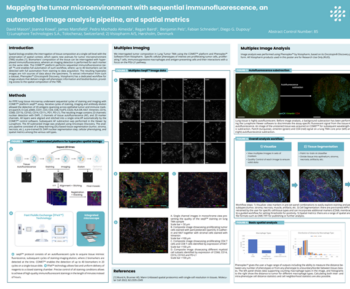
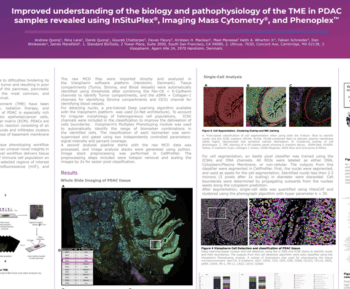
Solid tumors’ complexity extends beyond the genetic and functional diversity of cancer cells to include the tumor microenvironment (TME). Understanding the TME’s complexity requires a comprehensive analysis of the composition, functional states, and spatial distribution of its cellular components.
In this session, we will explore the application of basic research discoveries through the Harmonic Output of Stromal Traits (HOST) for the evaluation of the TME. HOST is designed to identify TME cells, while the HOST-Factor quantifies their functional states. The HOST-Factor is a numerical value reflecting the relative contribution of cancer-associated fibroblasts (CAFs) to tumor-suppressive or tumor-promoting functions.
Our workflow combines automated high-plex immunofluorescent microscopy with AI-guided image analysis to generate single-cell HOST-Factor values. This approach, applicable to the entire TME or specific regions of interest, provides spatial distribution data and identifies potential tumor-promoting or suppressive neighborhoods.
This talk will highlight the application of Visiopharm’s Phenoplex workflow and its Neighbor Counts module to identify and evaluate HOST+ CAF populations and their spatial distribution. Developed specifically for a pancreatic cancer clinical trial at Fox Chase Cancer Center, this user-friendly pipeline is flexible and useful for assessing diverse stromal compartments in distinct solid tumor cases.

Janusz Franco-Barraza. MD, PhD
Dr. Franco-Barraza obtained his Ph.D. in Molecular Biomedicine in 2010 from CINVESTAV-IPN (Center for Research and Advanced Studies of the National Polytechnic Institute, Mexico). During his postdoctoral work at Fox Chase Cancer Center, he studied integrin-based activation mechanisms used by cancer-associated fibroblasts (CAF) within their self-secreted extracellular matrix (ECM), acting as complex entities called CAF units. He focuses on understanding the functional traits of these CAF units and their roles in tumor promotion or suppression.
Utilizing approaches including multiplexed immunofluorescence and artificial intelligence (AI)-driven digital image mining, he is dedicated to understanding the prevalence and interplay of CAF units with other resident cells within the tumor microenvironment. Currently, his research aims to profile the stroma of cancer patients to validate and implement fibroblastic biomarker signatures that could predict treatment responses and disease outcomes.