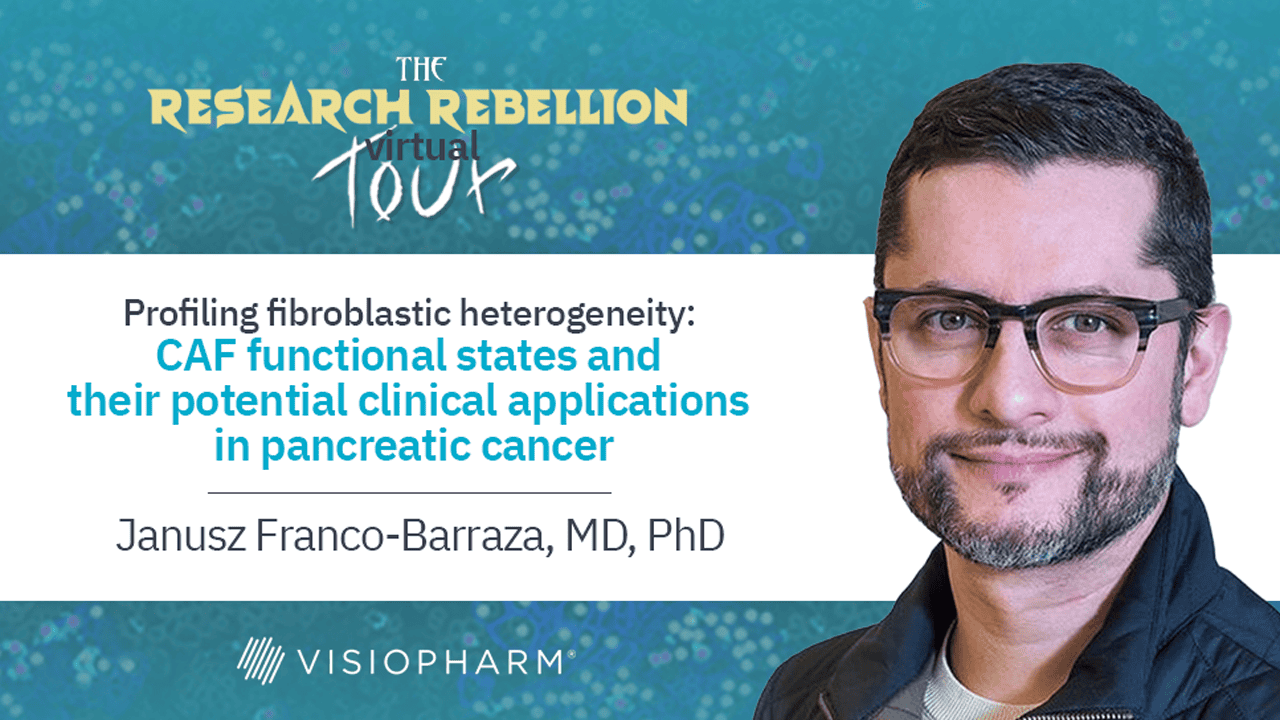
Profiling fibroblastic heterogeneity: CAF functional states and their potential clinical applications in pancreatic cancer
Transcript
I want to thank Visiopharm for the opportunity to showcase our ongoing research in this forum.
My disclosure?
Under normal conditions, the stroma acts as a natural barrier against tumor growth.
When that balance breaks down, the stromal environment flips to tumor restrictive to tumor supportive, a fertile soil for tumor seeds to thrive, as suggested by Pajet in his seed and soil theory.
Pancreatic adenocarcinoma, shown here in yellow, is a prime example overwhelmed by a dense fibrotic stroma called the desmoplastic reaction, seen here in blue.
This stroma is mainly composed and sustained by cancer associated fibroblasts and their secreted extracellular matrix acting together as what we call CAF units.
Years of research from our group on carcinoma associated fibroblast biology have revealed a set of key tumor supportive signaling pathways spanning from TGF beta signaling, extracellular matrix architecture, cytoskeleton remodeling, neuronal synapse elements expression, and stromal extracellular vesicles secretion.
Individually, each of these has demonstrated measurable impact on PDAC patient outcomes. Together, they reflect the dynamic nature of calf functional states capable of shifting the tumor microenvironment toward either a tumor supportive or a tumor restrictive environment.
As part of an oncology hospital, translating our findings clinically has always been a priority.
That opportunity came through Doctor. Joshua Mayer, a radiation oncologist at Fox Chase Cancer Center. His work showed that pulse low dose radiotherapy, called PLDR, shows significantly reduced toxicity in healthy tissues compared to conventional radiotherapy called CRT, evidenced by lower TGF beta production in healthy tissues as shown in these mouse colon images.
Since TGF beta is a master driver of desmoplasia in PDAC, PLDR became a compelling bridge between our stromal biology research and a clinical intervention.
Working with talented members of the Zuckerman lab, we tested in vitro patient derived CAF units responses to treatment mimicking total neoadjuvant therapy combining chemotherapy agent with PLDR.
Using a novel scoring tool called the Harmonic Output of a Stromal Traits Factor or host factor, we quantify a significant reduction in tumor supportive activity. The full details are in our recent publication. Please scan the QR code to read it.
These results brought research, radiation oncology, and surgery teams together into a phase one clinical trial evaluating radiotherapy dose escalation within total neoadjuvant therapy based on PLDR.
I’m proud to contribute to this study by characterizing the tumor microenvironment in pre and post treatment surgical specimens, applying the host factor to assess whether standard versus high dose PLDR shifts CAF unit’s activity toward a less tumor supportive environment.
To truly understand the tumor microenvironment dynamics, learning the cell content alone isn’t enough.
We need to know where these cells are and who they are talking to.
The tumor microenvironment biology has now gone spatial.
Much like astronomers are mapping the macrocosmos, we can now cartograph the tumor microcosmos, evaluating not just the biomarkers that are there or the cells that are carrying these, but also the precise location and relationships of every cellular player within the tissue.
We can achieve this by using sequential immunofluorescence on the comment instrument, detecting multiple markers simultaneously to build information dense images of the tumor tissue.
These images are then analyzed in Visopharm where AI trained pipelines like Phenoplex allow us to interrogate each cell’s identity and its precise location within the microenvironment.
Phenoplex works at a single cell level, detecting and segmenting nuclei and predicting cytoplasmic boundaries for subcellular analysis.
It essentially functions like flow cytometry by retaining the spatial context of these cells.
By assessing marker expression across thousands of cells within the tissue, it’s possible to assign to each one an identity based on the expression profile.
For each marker, signal intensity is thresholded to eliminate noise and fluorescent artifacts, as shown in this histogram.
Critically, these threshold values are applied uniformly across all samples to ensure consistency.
The result? Well, each cell can be unambiguously classified by its unique combination of marker expression.
Using phenoplex, we built a pilot framework to specially identify host positive CAF units comparing normal pancreas against pancreatic adenocarcinoma tissue.
As shown in these images, the workflow begins by detecting the tissue area, then moves into single cell segmentation, and resolves the cellular content within the tissue area.
From marker positivity, we can refine each cell’s phenotype and quantify population abundance.
The comparison here makes something immediately visible, a dramatic expansion of pan cytokeratin negative CD45 negative by mentin positive fibroblastic cells in pirac tissue relatively to normal pancreas.
This is the desmoplastic burden I described at the beginning, now especially resolved.
Building on our previous biological findings, which show the coexisting of markers in these CAP units across PDAC progression, we query in this population the presence of double positive cells and corroborated our previous reports.
This serve as the rationale to define more complex CAF unit functional states characterized by multiple expression of additional tumor supportive traits rather than single markers alone.
In this pilot, we focus on an specific tetra positive CAF unit functional state, host four positive, and compare its presence between normal pancreas and PDAC tissue.
Using this approach, we identify an increased presence of host four positive calf units within the desmoplastic content of this PDAC tissue.
Each yellow dot you see marks the precise location of one of these cells, especially embedded within the tumor stroma.
We then use Phenoplex to evaluate neighboring cells within ten microns of each host four positive CAF unit. Interestingly, these fibroblasts were found to be predominantly associated with immune cells, not tumor cells. As shown here, on average, each host four positive CAF had three immune cells in its immediate vicinity.
Drilling deeper, we found roughly two B cells, two T helpers, and two T cytotoxic cells near every host four CAB unit. But what stands out is their functional state, low proliferation, minimal granzyme expression, and almost one in every two T cells were positive for PD-one.
These are hallmarks of immune exuction, placing host four CAF units directly within immunosuppressed and tumor supportive niches.
With our spatial proteomics analysis pipeline established and the clinical trial approval ongoing, we took a parallel approach, selecting sex and age matched archive cases of patients treated with a CRT based total neoadjuvant therapy and treatment naive PDAC patients, we leverage our biosample repository to construct a COMET tailored tumor microarray comprising thirty six cases to arrange our controls cohort.
For this control study, we designed a twenty six plex marker panel covering the three major tissue compartments, epithelial, fibroblastic, and immune.
Markers were selected to interrogate CAF unit functional states and immune subpopulations with additional markers for cell proliferation and DNA damage to capture therapy induced stress, which I will detail in the next slides.
We then apply our pipeline to treatment naive and CRT treated cases. Two examples from each are shown here.
To streamline the analysis, our Poltox Sergio developed SPRAND, a Python based algorithm that characterizes all cell populations from marker expression combinations, quantifies their content, and generates graphical distributions for rapid screening.
You can access it via the QR code.
These graphs summarize the main cell population shifts between treatment naive and total neoadjuvant treated cases, suggesting a moderate reduction in tumor cells, an increase in calf units, and a profound reduction in immune cells.
Notably, there is also a sizable population of uncharacterized cells, ones for which our current panel lack markers and worth flagging for future investigation.
For calf unit states, we use a combination of twelve established and novel markers for which I can only mention their function.
Covering calf functionality, signaling immune suppression, and DNA damage.
To focus the analysis, these data set were filtered using two criteria. One, the phenotypes might be present in at least zero point five percent of the total cell population, roughly fifty cells per every ten thousand, and detected in at least ten percent of the cases in each cohort.
These CAF unit states were then classified using a tier based system ordered by complexity from foundational single functions to maximal integration where three or more functions coexist within a single cell.
Each tier reflects an increasingly complex biological behavior within the tumor microenvironment.
Two details stood out immediately. First, the treated cohort showed notably less phenotypic diversity than the treatment naive group. Second, functional states either cluster as group specific or were shared between both groups, pointing to a common foundational set of CAF units that persist across PDAC regardless of treatment.
The common functional states span mid to high complexity with PhosphoFac, pap alpha, and phospho smat two as the most frequently detected markers.
In the graph, the standard difference is in the unknown CAF units, which increase significantly in the treated group.
Four additional functional states also show significant differences.
These common functional states are anchored by phosphoFac and FabAlpha co expression, consistent with tjpeta driven stromal remodeling and immune exclusion.
Additionally, we observed a noticeable enrichment of PD L1 and CTLA-four in CAF units, specifically in treatment naive cases, pointing to an active immune checkpoint rich landscape in untreated PDX trauma.
Interestingly, we observe a trend toward an increased active TGF beta signaling in the treated calf units, consistent with Doctor. Meijer’s observation in radio sensitive tissue following conventional radiotherapy.
Additionally, post treatment CAF also show evidence of DNA repair activity suggesting the stroma actively responded to the therapy.
Turning now to the treatment naive unit landscape.
Calf unit states were cold positive in this group only if they were present in more than zero point five percent of the cell population, making them effectively absent in the post treatment group.
Of note, these treatment naive exclusive phenotypes were evidently enriched in PD L1 and CTLA-four, besides the foundational, phosphoFAC and Fab alpha, and standing out as the most prominent.
As noted earlier, the foundational CAF unit states were further enriched with alpha SMa and immune checkpoint ligands. Together, they were reinforcing the well established view of the untreated PDAC microenvironment as highly immunosuppressive niche.
In contrast, post treatment CAF showed enriched TGF beta and cell cell interaction signaling.
But notably, no expansion of immune checkpoint ligands beyond the already known and shared.
This pattern strongly suggests that therapy drives a meaningful reconfiguration of the CAF unit landscape as described in other studies.
In summary, we observed meaningful differences in the CAF unit repertoire between these groups, although this requires validation, given that this control cohort is composed of a non paired pre- and post treatment samples.
Critically, however, both scenarios carry signs of a tumor supportive niche sustained by TGF beta signaling.
We then apply the same analytical framework to the immune compartment using a fourteen marker panel designed to capture the major immune cell players, their activation and immunosuppression states, and signs of therapy induced cellular stress.
Briefly, both cohorts share an immunosuppressive T helper enriched baseline.
The treatment naive group layers Tregs on top, while the treated group instead accumulates NK and NK like CD8 T cells, but these are inactive.
Combined with the CAB unit’s landscape, we see two distinct TJ beta driven microenvironments, different in composition, but with similar immunosuppressive outcome, underscoring the need for multi target interventions.
Before concluding, I want to highlight an exciting collaboration with Doctor. Haiyan Li.
We are integrating our still ongoing spatial proteomics data with tissue neighboring features to train machine learning models capable of predicting whether a given microenvironment is tumor restrictive or supportive, aiming to build clinical decision tools to guide treatment strategies at the individual case level.
Early results from our logistic regression model are promising. Training on the full marker set yields the strongest predictive performance with an AUC, area under the curve, approaching to one point zero. Notably, CAF unit states and immune subpopulations alone follow closely behind, suggesting that a focused smaller panel could be sufficient and making this approach far more practical and cost sustainable for clinical deployment.
Finally, to close, I want to say that single cell digital platforms like Visopharm are essential for resolving the functional complexity of CAF units and immune crosstalk in the tumor microenvironment.
Our data show that untreated pDAC harbors, a TGF beta driven immunosuppressive landscape and that neoadjuvant therapy, rather than dismantling it, reshapes it into a different but equally suppressive niche with NK and subpopulations of CD8 T cells present jet silence.
Both scenarios converge on a tumor supportive microenvironment, reinforcing the need for multi target strategies.
And finally, machine learning models trained on a spatial tumor microenvironment features hold real promises as unbiased, data driven tools for predicting treatment response and guiding personalized therapy decisions.
With this, I want to thank you all for your attention. I want to acknowledge our pancreatic cancer patients and families and all the people behind these ongoing projects as well as the funding agencies that have been supporting us.
Thank you very much.
Understanding the heterogeneity of the tumor microenvironment (TME) and its functional impact in solid tumors requires detailed examination of its cellular composition, the functional states of its cell populations, and their spatial organization within defined microenvironmental niches. This presentation will showcase data from an ongoing study utilizing the Harmonic Output of Stromal Traits (HOST), a research-driven framework for characterizing subsets of TME cells. HOST computes quantitative scores, called HOST-Factors, that distinguish pro-tumor and anti-tumor functional statuses across cellular populations and their respective niches. In particular, this talk will highlight the use of the HOST-Factor for profiling human pancreatic cancer-associated fibroblasts (CAFs) alongside key immunogenic and immunotolerant immune infiltrates, with a focus on evaluating their overall tumor-restrictive (TR) versus tumor-supportive (TS) roles.
Pancreatic ductal adenocarcinoma (PDAC) is profoundly influenced by its CAF-rich TME, which consists of active fibroblasts forming functional units with their self-generated extracellular matrix. To assess how this TME responds to therapy using the fibroblastic HOST-Factor, we are analyzing surgical specimens collected from a clinical trial at Fox Chase Cancer Center.
Our integrated workflow combines a curated set of CAF and immune cell biomarkers, automated high-plex immunofluorescence microscopy, and AI-guided image analysis using Visiopharm®. This pipeline assigns single-cell HOST-Factor values, enabling spatial mapping of functionally distinct CAFs and immune cells. By identifying TS and TR neighborhoods within the TME, this approach could offer novel insights into the fibroblastic and immune landscape’s response to therapy and open the possibility to support more precise patient stratification for personalized treatment decisions.

Janusz Franco-Barraza, MD, PhD
Janusz Franco-Barraza, MD, PhD is an Assistant Research Professor and Manager of the Spatial Immuno-Proteomics Facility at Fox Chase Cancer Center. His research is dedicated to uncovering how cancer-associated fibroblasts (CAFs) shape the tumor microenvironment and contribute to either tumor progression or restraint. Recognized for his expertise in high-plex immunofluorescence and AI-driven spatial analysis, Dr Franco-Barraza studies the dynamics of fibroblastic biology using relevant biomarker signatures that reveal the functional states of CAFs and their relationship to tumor development. His work provides insights that may help predict patient outcomes and responses to cancer therapies.