Transcript
This matter of really changing everything to digital was like breaking the sound barrier, you know, till there is always stressing, and suddenly everything is quiet.
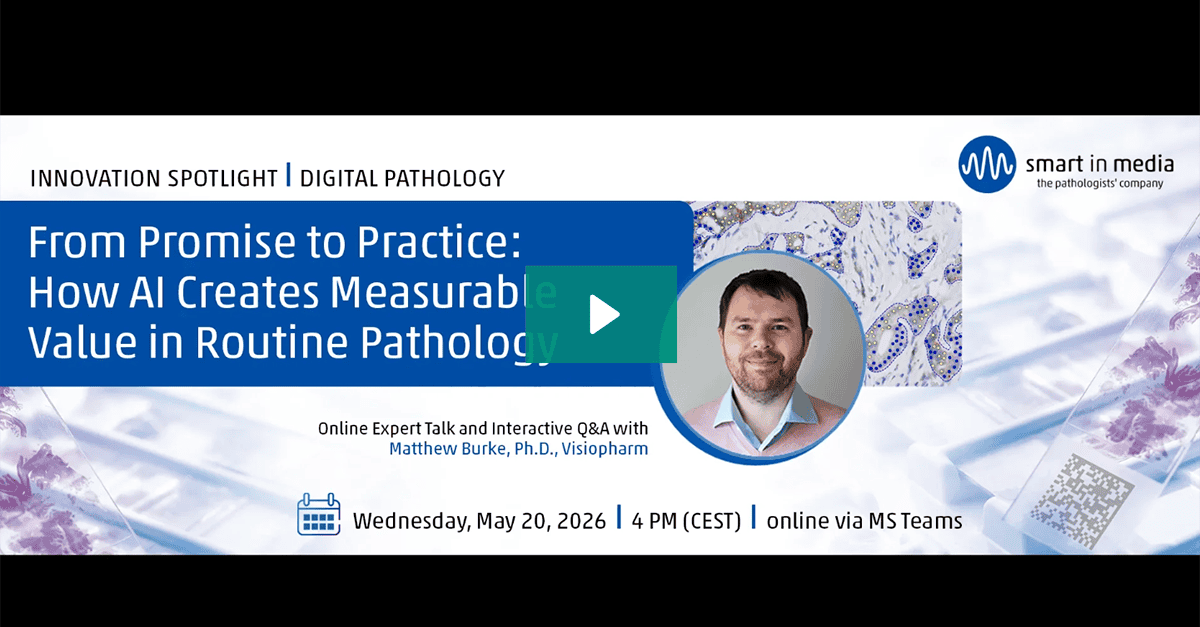
Hello everyone and welcome to today’s Innovation Spotlight Digital Pathology.
My name is at SmartMedia and I’m very pleased to welcome you to this online session.
Today we will talk about one of the most discussed topics in pathology, artificial intelligence.
But we will not look at AI just as a buzzword or as a distant future scenario. We want to discuss today a very practical question: Where does AI create measurable value in daily diagnostics routine?
But before we start, just a few words about smart media for those who don’t know us.
With our Partizome product family. We support pathology institutes, hospitals, universities and labs in moving from microscope based workflows to digital diagnostics to digital teaching and remote collaboration, and also to AI supported workflows.
One important principle of our solutions is openers.
Our platforms are designed to work with different scanners, different workflows and different AI modules.
We believe that digital pathology should not lock labs into one closed ecosystem, instead it should give them the flexibility to use tools, technologies and AI applications that best support their special diagnostic work.
And this is exactly why today’s topic is so relevant. AI is becoming and will continue to become an essential part of digital pathology, not as a replacement for pathologists, of course, but as a powerful support system for standardization, efficiency and more reproducible diagnostics. That’s why I’m especially happy to welcome today’s guest. It’s Matthew Burke from Visiopharm.
Visiopharm has been active in the field of image analysis and AI for pathology for more than two decades and is one of our partners in the digital pathology system.
The company brings a broad experience in AI applications, biomarker assessment, routine diagnostics and scientific validation.
Now Matthew is up to you. Would you like introduce yourself before we start deeper into the topic of AI?
Yeah, happy to. No problem at all, and thank you Karina for the opportunity to speak today. So yes, my name is Matthew Berg, I am the senior account executive for clinical solutions for Visiopharm. And I’ve been working with Visiopharm for, a couple of years now, but my, experience with Visiopharm goes back, over a decade.
So I am a scientist by training, and I have a PhD in neuropathology. And I actually used Visiopharm software as part of my PhD many, many years ago. So I have a real true belief in, you know, the use of image analysis, its benefit for, you know, patient care, and these kind of areas, etcetera. But it’s been a real journey for myself to kind of come full circle and come, you know, from a kind of a user at one level a long, long time ago in a research field through to then having the experience of I worked in digital pathology for the last fifteen years, with a number of different companies to see it coming into the the maturity now from the as you described before, Corina, where it was, you know, the early ideas and how it’s been used to being really deployed now and routinely used.
And we are seeing more and more of that and really excited to share some of our knowledge, my own personal experiences within this space as well.
Pathology labs are facing increasing pressure from multiple directions today. What do you think? What are the biggest challenges right now, and where can AI help?
Yeah. So, I mean, I think it’s, you know, whenever I go into any labs across, you know, Europe as I travel around and speak and see other, you know, labs, etcetera, Everyone is is seeing that growing demand that you described. I mean, that comes in a number of different areas. It could be, you know, a shortage of pathologists that is is kind of causing that.
But I also see it coming particularly with the work flow and the workload in the actual lab. So people are being asked to do more work, you know, almost with probably less people, unfortunately. There there is a lack of resources within the laboratory. What we see really, I think, around that is not, you know, just the volume of the lamps, but it really is that complexity.
I mean, I have a a couple of slides, you know, that I can just kind of touch on just to give a little bit more kind of, color maybe to to this discussion as well. So I’ll share my screen if that’s okay, and we’ll we’ll we’ll jump jump around, and that’ll just be used really for for reference.
But as I say, I think it’s really that kind of complexity that we see, you know, with an aspect. And many people on this call will will appreciate this, I hope, with, you know, how we’re seeing predictive markers coming in now. So it’s not just the kind of, you know, case load, but it’s actually that complexity. You know?
It’s great that we now have these kind of treatments like Herceptin, like drugs for for lung cancer, etcetera, as well, which are linked back to specific markers that come from pathology like two, like p d l one, etcetera. But it’s not a case now of just saying, yes. It’s present. No.
It’s not. It’s the grading of how much is present within that. And this is where we really see the kind of challenges that labs are facing. It’s this complexity, this difficulty.
Do you go and ask for a second opinion at this point, particularly around kind of thresholds and and cutoffs? And so, you know, we really see that’s where labs have been struggling and and continue to struggle.
There has, you know, historically been you know, a lot of AI has been developed that’s kind of focused on things like primary diagnosis, so in, breast cancer, for example, etcetera, which serves a really good purpose.
But the challenges that you really then start to see with that is that a pathologist can look at a slide quite quickly and tell you it’s benign or it’s malignant. When you’re looking at, you know, these kind of tests, and we’re seeing more and more of these antibody drug con contingents, ADCs, coming down the pathway, which is going to put more pressures on more markers that are required. We really need to think about how the efficiency across the entire lab can work. So, yeah, having an AI for primary diagnosis is, you know, very beneficial and useful, but we really see that the value can be in that kind of those difficult cases, as I as I mentioned before.
So your HER twos, your PD L ones, etcetera, in this space. And that can work in multiple different factors. Obviously, looking just specifically at the pathologist is, you know, one thing. Can it help speed up that kind of process?
But, really, it’s the wider kind of discussion. If you’re able to reduce the number of secondary tests that need to be performed or rework that needs to be done, then this can also have a benefit across the entirety of the lab. And whilst many labs have, you know, many specialists, they all rely on the same lab that they’re working within in that space. So, you know, if you can reduce the workload from breast pathology, that will probably help all of the other areas as well.
So it doesn’t necessarily have to be an algorithm that fixes everything, but I think there’s a a real aspect to, to looking at the whole process. And, again, I think that measurement of what is speeding up, often we talk about pathologists, how quickly do they review a case, but we should really look at the whole holistic overview of, as said, if you have to request a second opinion and you have to send out slides or you even have to just find your colleague to, to touch on and check on something, It takes significant amount of time to go through that process, and that might mean a patient misses out on a an MDT meeting and can’t start their treatment, for example.
That really adds stress, you know, to that to that patient, but also I think it really builds the workload and the backlog that we see within labs. So we’re very much focused, in that area, and I and that’s my belief is that AI can really benefit in in these areas, predominantly.
I think these are very important points because AI is often discussed in a very abstract way.
But for the absolute question is always where does this actually support the diagnostic workflow?
And one of the areas where this becomes especially valuable is the biomarker scoring assay, and this is one of the most discussed applications.
What do you think, how does it improve accuracy and reproducibility?
Yeah, absolutely. So I mean, Visiopharm has a wide number of algorithms that have been clinically approved and our CIB are released and have gone through that clinical validation. I’ll now, you know, possibly touch on some of that a little bit later, but we really focused on the on these kind of biomarkers. So we have the the breast panel that you can see here. So your ERPR t sixty seven HER two. And, again, we also have the PD L one algorithm for non small cell lung cancer.
But, also, as you say, it’s really about kind of how do you, you know, do accuracy, reproducibility. Well, AI is great because it follows specific rules. So, you know, obviously, you show, you know, the algorithm at image today. If you take that image back in a year’s time and run the set, you will get exactly the same results in that case. Right? If I go back to my training days and look at a case and then look at it two weeks later, there’s a chance I might give a different outcome from that depending on, you know, my interpretations from earlier in the day, many of the factors of maybe even just the area that I’m looking at on the slide kind of thing could determine what the outcomes could be. Obviously, the analysis is taking a a whole slide image analysis and can be counting thousands, if not hundreds of thousands of cells.
So the analysis really helps to reduce that kind of eyeballing, you know, kind of saying, why is this? I counted a hundred cells. Is it a hundred and twenty cells, etcetera. It really gives you an accurate accurate and quantifiable numbers.
It gives you your kind of accuracy. But, you know, part of the the issues that we face with AI still in this regard is that, you know, fundamentally, the algorithm is looking at pixel data. Okay? So if, you know, the staining that or the image that we provide is problematic, difficult, etcetera, the AI is not perfect.
It can’t then, you know, kinda determine what, you know, the actual changes are or what the actual impact is. So, you know, I’m sure, you know, people have an overview on this and and, you know, can kinda see.
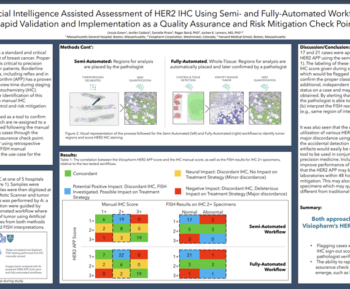
We can really kind of consider this and and obviously take into the actual algorithms that we run. I think it’s key as well that the algorithm really does run without fully automated workflow. So, again, you know, from a, you know, accuracy reproducibility kind of element, If people have had experiences with AI in the past, Visiopharm used to have this situation, you would draw a region of interest yourself kind of thing. The algorithms now are much more automated and can, you know, ignore the control tissue automatically. They can find, you know, the invasive tumor regions, which is the area that we actually want to analyze and measure. So we’re not kind of having that kind of aspect. But it also that helps very much with the workflow.
But we also need to consider as well, as I said, it’s that kind of staining consistency. So for IHC and for biomarkers that we’re looking at, you know, it’s very easy for a you know, to look via eye, in this image that you can see here, where you have a a significant difference between your staining one day as weaker, one day stronger, and you can make an interpretation about that. But I’m sure many people on the call will be you know, have this experience of their own life, that the staining will change over time, actually over quite short periods of time. And depending on the platform you’re using, there are many different factors that that can be.
So daily, you can actually have some variety. And currently, we don’t really manage this particularly or control for this very well. We do QC checks on our staining and say, yes. It’s stained.
No. Hasn’t. But it’s very qualitative. That, you know, qualitative assessment could change day to day by just surely the fact, Karina, if it’s I look at the slides today and tomorrow you’re on QC, what’s your interpretation?
Are we, you know, in the exact same space? And so using AI and image analysis, you know, Visiopharm developed a solution where we’re actually able to track and record how staining actually changes over time, and that can really help a lab to understand and really look into what is happening with those with those markers, which, again, I think is a real forerunner for actually running AI and making sure that we are getting that kind of reproducibility.
What, you know, a platform like that can also do, so we have a a platform called Qualtopics that does this, where we can provide scores against control material. And that can really, as I said, one, give you you know you’re getting reproducible results therein, you know, the, aspects that you say is acceptable. But, also, we can help a lab detect issues with the assays, with the protocols, maybe with instruments. And, that kind of rolls back to, you know, those kind of challenges that labs are facing. They’re all under pressure. They’re all trying to work through things, but they’re not you know, the if the if the stain is down, that might impact what they can actually do with their workload and and, you know, all these other kind of bottlenecks.
So, you know, this platform has really helped labs across Europe to kind of identify those problems, you know, really try to align up and make sure they’re getting that standardization, reproducibility, and really full use of their platform as well.
So you talk about the higher accuracy and consistency, and it’s important for the patient benefit. What do you think? How does this translate into benefits for routine diagnostics?
Of course, that’s really the most important thing. That’s why we’re all here, right? It’s to serve our patients. It’s to make sure that the patient, particularly around these biomarkers, fundamentally we’re using these biomarkers to identify the patient to get the correct treatment. And again, that really falls back to the pathology department.
But, you know, equally within that, we know that, you know, there are specific challenges that the labs face. You know, as said, we’ve got to look for those benefits. It’s fundamentally, again, it’s it’s a different way of working, and these things have to pay for themselves.
And so we have to look at, you know, where there is actually a business case to, you know, run these kind of algorithms. So one of the big challenges that we see in labs, today is in in HER two, and it’s that kind of classic, you know, having a high two plus rate.
And that’s often caused by, you know, pathologists wanting to do the right thing. They want patients to have the best possible opportunity to get that Herceptin treatment. And that two plus is there as a kind of, you know, guideline of we will run a reflex test and see if that works. And it that then really adds, you know, a situation because if a pathologist or the let’s take it the whole team that actually does the work has to run that reflex test, you know, for the, you know, platform.
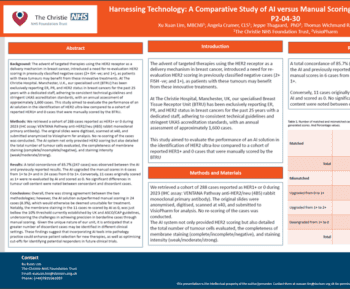
It adds a lot of time to the actual case workload. There’s costs associated with running extra tests and what have you. And what we’ve seen with our, you know, HER two algorithm is we’re able to give a continuous quantitative measurement against every tumor cell within a sample. And from that, we’re really able to get a quantifiable, agreed result at the end of it.
And what we have done with our algorithm is we have optimized that against reflex testing, such as FISH. And so we’ve actually been able to show labs are able to reduce down their HER two plus rate from sometimes we’ve seen labs that were as high as forty, fifty percent of their, two percent to below twenty percent, which is really what the global expectation is. And as I said, that kind of can help not only a lab with saving time, saving money, but also means that that patient has the best possible chance to, you know, get into their treatment. So if they’re not, you know, going to get Herceptin treatments, you know, in the future because that reflex test is not going to amplify, then, you know, we might as well get started on the treatment that they are entitled to instead of pushing that back.
And I know cases in Europe where sometimes that test can take many weeks before the results come back, and that just adds to the stress of patients.
But we’re also seeing as well today, you know, within that, is the kind of thinking around HER2 low and ultra low, and this is becoming a real challenge for pathologists. They’re not all having to report this today, depends if, and HER2 has been approved within the market that people are working with.
But there is no fallback like reflex testing today for HER two low or ultra low. And so it’s a real challenge for labs, how they’re going to manage this. You know, it’s also, are they going to have to always get second opinions on these cases? How do we decide if these patients should get this treatment?
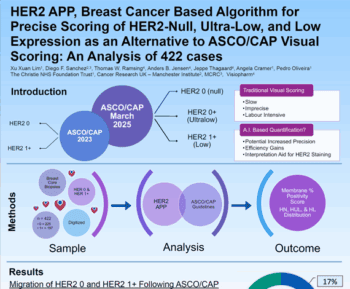
Which is obviously very important. And there’s been recently a publication that used the, the Visiopharm algorithm, so this is from UK Nequest in the UK, where they worked with sixteen expert breast pathologists who looked at a cohort of fifty breast cancer biopsies, and that kind of work that was particularly enriched for the HER2 low kind of cohort. They said, Okay, let’s see what everyone thinks of these breast biopsies. How does that work?
What’s the level of agreement? And sure many of you who are on this call, and Karina I’m sure you’re experienced with some of you pathologists, you put many pathologists in a room, you’ll get many different answers. Right? So that’s exactly what you see in the data.
And what you see is these kappa scores. So if you’ve got a kappa of one, that basically means you’ve got absolute agreement. If you got a lower kappa score, then you’ve got disagreement. And, again, this is showing the range here at the moment of those cases.
So in this enriched group, there is still some two pluses, three pluses, etcetera. So you can see that all cases come. So you have some pathologists who got really good agreement for it at the top, but equally, you’ve got some who are a much lower level of agreement. Some who will call it a zero when it was a one, a one when it was a two, of that kind of breakup.
What you can see here is that the algorithm comes, you know, very nicely. It’s in the middle of this kind of group, you know, for all of those. And when we actually look at just the, high level of agreements, we’re really at that top end again. So it’s really, you know, ninety one percent kind of level of agreements where, you know, some pathologists are a little bit lower down on that space.
And that’s, you know, in sixteen of, you know, the expert breast pathologists in the UK who review these, like, this is, you know, really the creme de la creme, the top of the top kind of thing, and they can’t agree. So, you know, it’s gonna be very difficult. Maybe in a, you know, hospital where you’re not a breast specialist or you don’t even have access to that where you then, you know, rely on this. Again, the algorithm can give you something and a different way of interpreting this and looking at that.
And again, in this study, we also found that factor that we mentioned before in regards to reducing the two plus rate. So, we saw a thirty three percent saving in ish testing and time. Again, we can make this paper available.
Even the best AI application only creates value if it can be introduced into the real world for a real workflow of a pathology lab.
And so what do you think? What should labs consider before introducing AI into their diagnostic workflow?
Yeah, absolutely. I mean, I think there’s a couple of, you know, key things. I think you’ve mentioned it yourself. Think an open system is critical.
Know, I work for Visiopharm, and, you know, we have our album. There are many of our algorithms on the market, and, you know, you should be able to access it and, you know, utilize, those themselves. I think that is, you know, important, I believe, but we have we have some really cutting edge algorithms in there. They’re, you know, they’re great.
I think one of the other aspects that we do see, I’m just gonna jump forward on some of my side, is really, again, the kind of the workflow is a key part, so prioritizing that kind of workflow. I kinda briefly touched on this before, but as I said, the the system can work automatically within the platform. But, really, you know, it’s that kind of people always say, how long does the AI take to analyze? Really, as an end user, it shouldn’t be a question.
Because what should really be happening, and we do with you yourselves at SmartMedia, is that we can actually say we get the image sent once it’s digitized, and then we can start the whole analysis process automatically without having a person hitting a go button or or what have you, when we get an output that comes out and can be relayed back to the smart and media viewer.
So I think that’s a really kind of important aspect of it. It’s really that kind of the workflow and and those kind of parts. Another side I think that I would touch on as well when people think about is people get often caught up by trying to do too much, I would say, at first. Are they trying to digitize everything?
And I actually think that there’s a real benefit to kind of targeting certain specific challenges that a laboratory might have. So, again, maybe it’s like the HER two kind of aspect or PD L one or or another marker, for example. I think there’s a real side that, you know, you don’t have to be able to do everything to do something. You can start with, you know, running a HER two test and, getting your analysis start on that.
I think it’s good to make a make a start on that. I think if a lab is starting as well in digital pathology, real key is to look at, you know, that Qualitopics platform. You know, if you’re looking at that, how do you get that consistency? How do you measure that to start with?
Because, really, everything is is kind of downstream, from there. And I think, finally, a really important aspect of, you know, if you’re looking to introduce, you know, AI today, you’re really making sure that you’re introducing, you know, truly clinically validated approved algorithms. So does the I I IVDR, directive? And it’s really, you know, is what people should be looking at for recognizing that an algorithm has gone through the rigors of that kind of clinical testing.
There are a number of algorithms still on the market that are IPDD. These will have to either be upgraded, you know, in the very near future, or they will be taken off the market. But I think, you know, if you’re looking you’re putting yourself at risk today if you are looking at an IVD algorithm, you know, even trusting that it will get over you know, purchasing an IVD, it’ll get over that, you know, benchmark by the time that the the requirements come. You know, you’re putting a lot of faith in that.
You don’t know what will actually happen in the future in that regard. I think you really should be, you know, kind of looking at those kind of if you’re going to use this for diagnostics, there really is a key of of looking at those IVDR algorithms primarily because of all of the extra things that as mentioned in this slide, the notify bodies, you know, the validation, the life cycle controls, all of these things, is the kind of aspect that you should consider for moving forward with AI.
So I think we see AI does not exist in isolation. No, no. So looking a little further ahead, how do you see AI reshaping pathology over the next three to five years?
Yeah. I mean, of course, I’m very passionate about this, and I’m very keen to to see it kind of become I think it will become more embedded, and I think it’ll just become part of the routine. I do think that will come through from the biomarkers and the companion diagnostics element. You already are seeing kind of TROP two as a marker, which comes with a companion algorithm that, you know, this is gonna become something that we will see in the future that if a patient is to get x type of treatment, not only will they have had to use x biomarker to identify, they’ll need to use x specific algorithm.
And I think that’s really the angle that I see, you know, kind of things coming in. But, also, I think that will then help pathologists that you don’t when PD L one was launched, it took years to kind of understand the staining profile and all of this kind of the algorithm can take a lot of that weight on kind of moving forward for labs. And I think that could be could be really beneficial for labs in the future. So I’m really you know, I’ve been in this field for fifteen years, but I’m really excited about the future, what that then means for kind of precision medicine.
And I really think precision medicine only will exist with precision pathology. So, you know, we’ve got to become quantifiable. We can’t keep living on eyeballing tests and kind of, oh, I feel it’s like this today, and two weeks down the line maybe I, you know, score it slightly differently because it’s sitting on one or the other side of a of a threshold. So, yeah, I think there’s some some really exciting things to come in the future.
So before we move into the q and a, would you like to give us a brief overview of your AI store?
This can be found on Visiopharm.com, you can go into our website, where we have lots of excellent information and interest, so otherwise research, diagnostics as well. There is a specific app center, but I’m just going to focus on diagnostic and the CIBDR apps that we provide, where you can kind of go in and have a look at the algorithms that we have here already and approved and good to go. So click on the PD L1 algorithm. You can see the the app that we have and the steps that it follows through and the kind of scoring outputs that you can receive.
And then, obviously, this can be supported through with integration with your your smart and media platform. So hopefully, this is a nice resource for, people to come and have a look at, and get some more information. Just to say, Karina, just to anyone that’s on this, chat who’s based in Germany, I’ll be coming to the conference in, Augsburg, next week. So, unfortunately, I’m only there for one day just due to personal reasons.
But I will be there on on Thursday, the the twenty eighth of May, and, we’ll be around the Smart Media, booth and and walking the floor as well. So, if anyone, would like to have a chat, would be more than happy to pick things up and maybe do some demos or something whilst I’m there as well.
So if there are no questions, thank you very much, Maestio. This was a very good bridge from the broader discussion of AI into the practical side of the AI adoption.
Thank you very much for sharing your insights. I think the session showed very clearly that AI and pathology is no longer just about technological potential. It’s here and it’s every day in our labs.
A big thank you also to everyone who joined us today. We hope this Innovation Spotlight gave you a useful and practical perspective on how AI is moving from promise to practice in pathology.
We will continue our innovation spotlight on digital pathology in the next months. In June, the topic is monitors, special monitors for pathology.
And we would inform you about the date and if you are joining us again we would be very happy!
So, have a nice evening!
Our Matthew Burke joined Corina Turner, from our partner Smart in Media for a conversation on how AI creates measurable value for pathology labs already today.
There are proven benefits of AI in clinical diagnostic: Higher accuracy, better reproducibility, clear clinical potential. But budget holders will still ask: Where’s the financial return? What is the value of AI in pathology?
This webinar answers the question by showing how customers already see and measure value in their daily routine.
What you’ll learn:
- How AI in clinical practice is more than fancy algorithms
- Key drivers behind successful adoption and scalability
- Real world evidence of tangible benefits for labs
- How AI can support both clinical outcomes and operational efficiency
AI in pathology won’t get funded on accuracy alone. But there is more to the story.
Visiopharm’s IVDR certified APPs can be integrated into Smart in Media’s PathoZoom® Digital Lab IMS for an optimized workflow.
About Smart in Media
As one of the world’s leading providers of digital pathology software, their PathoZoom® solutions support pathologists in effective diagnostics and teaching, from small solutions to full digitization. With many years of experience, their teams in Europe and USA support you from small solutions to full digitization.

Matthew Burke, PhD
Matthew Burke, PhD, is a business development leader specializing in digital pathology and AI-driven precision diagnostics. He brings over a decade of experience advancing digital pathology adoption at companies such as Philips, Hamamatsu, and now Visiopharm. His work focuses on expanding access to technologies that improve diagnostic accuracy, efficiency, and ultimately, patient outcomes.