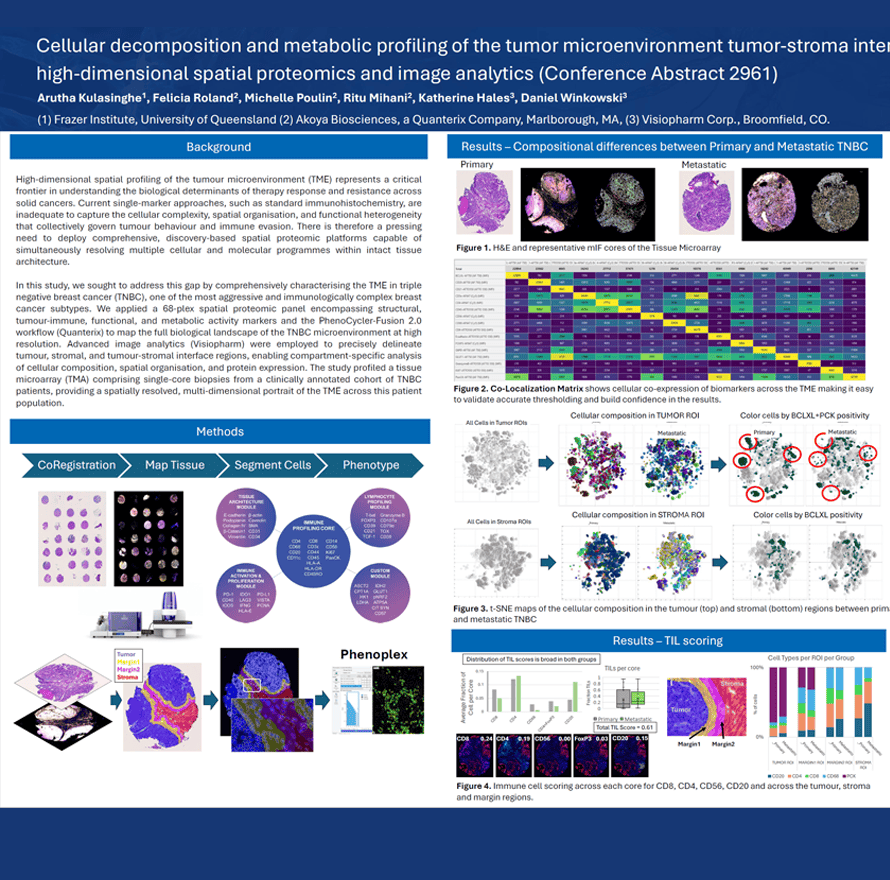
High-dimensional spatial profiling of the tumour microenvironment (TME) represents a critical frontier in understanding the biological determinants of therapy response and resistance across solid cancers. Current single-marker approaches, such as standard immunohistochemistry, are inadequate to capture the cellular complexity, spatial organisation, and functional heterogeneity that collectively govern tumour behaviour and immune evasion. There is therefore a pressing need to deploy comprehensive, discovery-based spatial proteomic platforms capable of simultaneously resolving multiple cellular and molecular programmes within intact tissue architecture.
In this study, we sought to address this gap by comprehensively characterising the TME in triple negative breast cancer (TNBC), one of the most aggressive and immunologically complex breast cancer subtypes. We applied a 68-plex spatial proteomic panel encompassing structural, tumour-immune, functional, and metabolic activity markers and the PhenoCycler-Fusion 2.0 workflow (Quanterix) to map the full biological landscape of the TNBC microenvironment at high resolution. Advanced image analytics (Visiopharm) were employed to precisely delineate tumour, stromal, and tumour-stromal interface regions, enabling compartment-specific analysis of cellular composition, spatial organisation, and protein expression. The study profiled a tissue microarray (TMA) comprising single-core biopsies from a clinically annotated cohort of TNBC patients, providing a spatially resolved, multi-dimensional portrait of the TME across this patient population.
Arutha Kulasinghe1, Felicia Roland2, Michelle Poulin2, Ritu Mihani2, Katherine Hales3, Daniel Winkowski, PhD3
- Frazer Institute, University of Queensland
- Akoya Biosciences, a Quanterix Company, Marlborough, MA
- Visiopharm Corp., Broomfield, CO.