
How Kalmar County Hospital integrates AI biomarker assessment into clinical practice in Sweden
We had the pleasure of speaking with Dr Suzanne Johansson, Pathologist at Kalmar county Hospital, who shared insights into her team’s journey implementing AI for biomarker assessment in their pathology lab in Sweden.
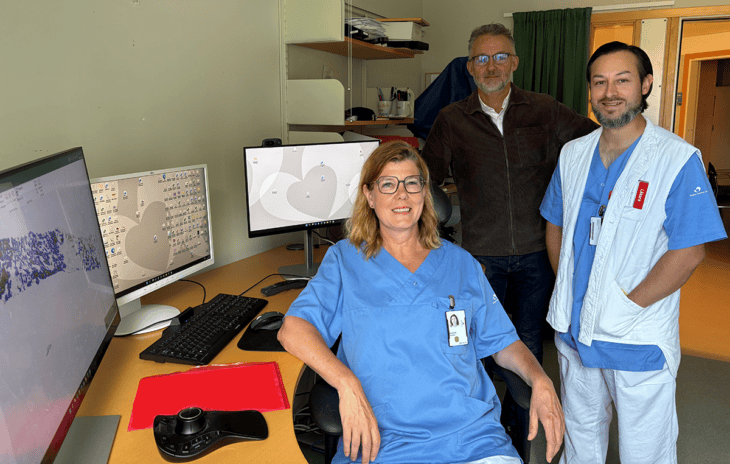
Suzanne Johansson, Senior Consultant in Pathology and Cytology
Hans Olsson, Senior Consultant in Pathology and Cytology
Charlie Bensefelt, Specialist in Pathology and Cytology
Suzanne Johansson has worked as a specialist in Pathology since 2009 and is head of the Breast Pathology and Skin Pathology sections in Kalmar.
The Pathology Department at Kalmar County Hospital is a typical Swedish regional hospital serving a population of approximately 250,000 residents. The department handles around 20,000 diagnostic cases annually and encompasses histopathology, autopsies, outpatient services, and parts of molecular pathology. The department consists of a team of specialist pathologists and physicians in training who work together across most pathology subspecialties.
Kalmar has long been an early adopter of digitalization within pathology.
What led you to search for a solution like Visiopharm? What type of problems or limits were you experiencing in the lab?
Above all, we were looking to improve reproducibility particularly for predictive and prognostic biomarkers. We started working with AI applications years ago and different alternatives have existed over the years, but none of them have been robust enough. So we’ve had this in the back of our minds for a long time. We tested different options, and other colleagues did the same. One of my former colleagues spent a long time evaluating various alternatives, but there really wasn’t any complete solution available. You still had to manually select the areas yourself and do a lot of the work.
We also wanted an open solution that could work with different scanners and LIS/LIMS systems and give us flexibility if we decide to make changes in the future. And of course we were looking for something that could deliver consistent, high-quality results.
Why did you choose Visiopharm, what made the difference?
Visiopharm had been mentioned in various presentations at events and we already had positive experiences with you from scanner sales. What made the difference for us was the ability to stay in control. We wanted a solution that supports the pathologist rather than replacing their judgement. The ability to review, adjust, add, or remove regions is very important. We can still take ownership of the case, remain responsible for the final assessment and are not locked into something that wasn’t correct. For example, in lobular cancer, if the AI has missed an area, you can add and you can still achieve a more accurate assessment, letting the AI perform the counting while you control the selected area.
Initially, we thought that we only needed Ki-67, because that is difficult to count, time-consuming, and should be done on whole sections. […] This was the biomarker where we believed reproducibility was weakest. Having AI for this would also save time, but above all the quality would increase.
When you started looking, was there a specific biomarker you had in mind? What was most interesting then?
Initially, we thought that we only needed Ki-67, because that is difficult to count, time-consuming, and should be done on whole sections. The other methods that exist are really just subjective, where you make a selection, but when counting the whole section, you get a more correct picture because more cells are counted. This was the biomarker where we believed reproducibility was weakest. Having AI for this would also save time, but above all the quality would increase.
However, once I started testing the applications, I realised there was also value in markers that I had considered straightforward, such as estrogen receptor. When values are around the threshold, they significantly impact treatment decisions, and my “pathologist brain” cannot reliably distinguish between, for example, 5% and 15% across several thousand cells.
I also highly value the stratification provided for HER2: how many 1+ cells, how many 2+, and how many 3+ are in the sample. This will become even more important as we move toward HER2 ultra-low classifications, which I think is going to become complicated. Actually, as it stands now, only a single positive cell is required to give treatment.

Example of HER2 analysis by Visiopharm
How has having the APP support changed the way you work?
For myself, I have observed that I often estimate higher Ki-67 values than the APP. With subjective assessment, at least in my case, my attention is drawn to positive cells, causing me to miss the larger number of negative ones. Cases I would previously consider intermediate, around 6–10%, may now fall into a lower category when evaluated more objectively.
When it comes to APPs for predictive and prognostic factors, I believe the main benefit is that they provide a more objective value. Depending on how we use them, they can also save time, for example, if we run the APPs before reviewing and assessing the case.
For H&E in metastasis detection, I see it more as a screening tool. Based on the cases I’ve reviewed, it has not missed a single metastasis, not even submicrometastases. It has very high sensitivity and does detect additional findings, but then you simply go and look at them and either confirm them or reject them. We still go in and review all slides, but as you get used to this, the process will become faster. It is helpful that the APP uses a gradient, red indicating a strong suspicion, while orange and yellow indicate weaker suspicion. There will definitely be time savings for us.
Can you describe the process of implementing Visiopharm, how was the experience with our team and were they any concerns in the lab?
The process has been good, with strong communication and accessibility. Very responsive. We’ve always received good and quick support.
Part of the concern was that we would not have control over it or fully understand how it had reached its conclusion. But now that I have the possibility to go in and review in detail how it has made the assessment, I feel more confident in deciding whether to accept the value or choose the conventional approach instead. I use it as a support tool: I remain in control and can see exactly how it worked.
How do you see the future of digital pathology in your laboratory?
Very positively, we look forward to it. We feel that it will help us in all the areas where assistance is possible. Currently, AI performs better when it comes to numerical assessments and quantification, while the pathologist is very good at morphology. You can see the development, that AI is becoming increasingly good at morphology as well. We believe that, when used in the right way, this will lead to more precise diagnostics while also saving us time.
I believe Visiopharm is an excellent solution.
The main advantage is that it gives us a better basis for our assessments. It provides better support for diagnostic decision-making and can make the evaluations fairer for patients as well.
What would you say to other laboratories that are considering a similar solution?
I would recommend spending time exploring and testing the technology before making a decision. It is important to understand both the benefits and the potential limitations so that you feel confident moving forward. I believe Visiopharm is an excellent solution. The main advantage is that it gives us a better basis for our assessments. It provides better support for diagnostic decision-making and can make the evaluations fairer for patients as well. It shouldn’t matter which pathologist a case happens to be assigned to. Especially in borderline cases, the assessment becomes more objective and even small differences in interpretation can have clinical significance. And that’s really the key point. This has been our goal for many years, and now products finally exist that we consider robust and stable.
Read more about our diagnostic solutions for pathology labs here.
If you would like to speak with your team about your current workflow, contact us here.
Share this article